
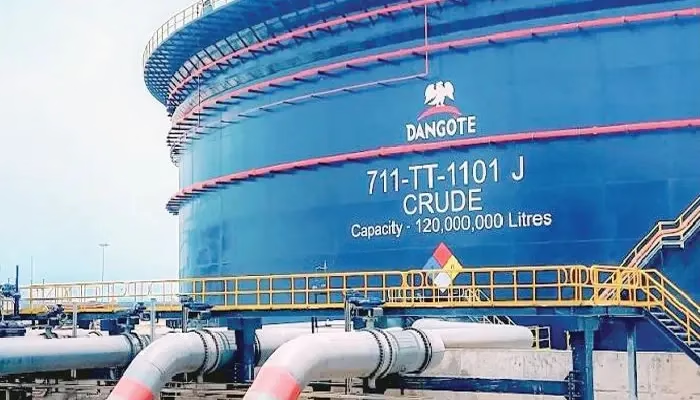
Nigerians have taken to social media to express their support for the Dangote Petroleum Refinery amid its dispute with the Nigeria Union of Petroleum and Natural Gas Workers (NUPENG). The union recently launched a nationwide strike, shutting down petrol distribution over alleged anti‑labour practices by the refinery. The strike was triggered by the refinery’s plan to deploy 4,000 compressed natural gas‑powered trucks for fuel distribution.
The Federal Government convened a meeting to address the crisis, but NUPENG reportedly shunned the session, and the outcome of the meeting has not been made public. Despite this, many Nigerians have rallied behind the Dangote Refinery on social media, arguing that the refinery’s innovation should not be hindered by the union’s actions. One user wrote that “Nigerians stand with the Dangote Group,” while another praised the refinery as “the only business leader that prioritizes the needs of ordinary citizens.” A professor added an analogy, suggesting that businesses should be allowed to innovate without interference from unions.
Not all Nigerians share this view. Some have expressed solidarity with NUPENG, which has received backing from other leading unions, including the Petroleum and Natural Gas Senior Staff Association of Nigeria, the Nigerian Association of Road Transport Owners, and the Nigerian Labour Congress. NUPENG President Williams Akporeha warned that the refinery’s actions could have far‑reaching consequences, likening them to taking the country “back to the days of slavery.”
The dispute between the Dangote Refinery and NUPENG has significant implications for Nigeria’s oil and gas industry. While the refinery’s plan to use compressed natural gas‑powered trucks is seen as a step toward innovation and efficiency, the union’s concerns about job losses and anti‑labour practices must also be considered. As the situation unfolds, it remains to be seen how the conflict will be resolved and what impact it will have on the industry.


Comments are closed for this story.