
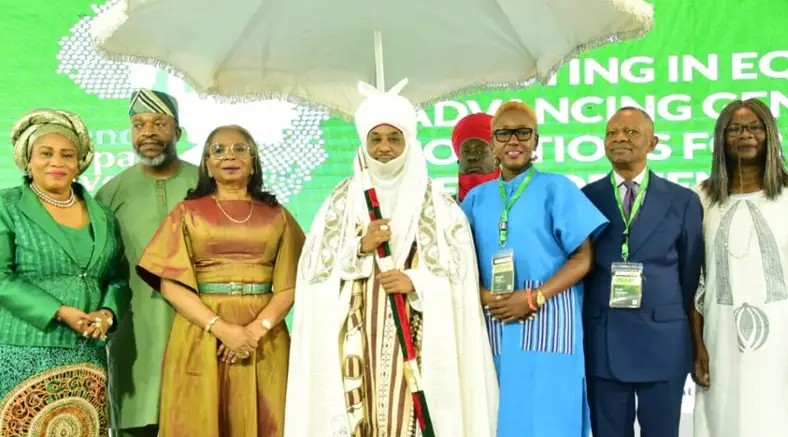
Muhammadu Sanusi II, the 16th Emir of Kano and former governor of the Central Bank of Nigeria, called for reforms to remove the barriers that limit Nigerian women’s participation in politics, business and leadership. Speaking at the 3rd Gender Impact Investment Summit in Lagos, he stressed that advancing gender equity is a matter of common sense—not charity—and is essential for Nigeria’s growth. Sanusi noted that the constitution requires each state to have a minister, yet diversity is considered only in geographic terms, not gender. He proposed reserving senatorial seats for female candidates on a rotational basis to guarantee representation, pointing out the current imbalance of only four women among 109 senators.
During his tenure at the Central Bank, Sanusi introduced policies that promoted women’s leadership, which contributed significantly to the bank’s achievements. He observed that women later headed critical departments, and their leadership helped drive broader reforms in the banking sector. This culminated in the 2012 “Year of Women in Banking,” which set gender targets for recruitment and leadership and resulted in nine Nigerian banks being led by female chief executives.
Sanusi also urged regulators such as the Securities and Exchange Commission and the National Insurance Commission to require gender‑disaggregated reporting, thereby improving accountability in lending to women‑led enterprises. He emphasized that solutions to women’s economic exclusion must be tailored to local contexts, as cultural barriers vary across regions.
Representing the Ministry of Innovation, Science and Technology, Rachel Ede pledged the federal government’s commitment to women‑inclusive growth under the Renewed Hope Agenda. Frank Aigbogun, chair of the Impact Investors Foundation, praised the launch of a 10‑year Gender Equity and Social Inclusion roadmap, which aims to mobilise $8 billion in gender‑inclusive capital to close financing gaps for women, youth and persons with disabilities.
The summit’s theme, “Investing in Equity: Advancing Gender‑Led Solutions for Inclusive Development,” underscored the importance of addressing gender disparities in Nigeria. Implementing the Gender Equity and Social Inclusion roadmap is expected to have a significant impact on the country’s growth and development by promoting women’s participation across sectors and removing existing barriers to their economic inclusion.

![Troops, terrorists exchange gunfire in Kogi [VIDEO]](https://mediatalkafrica.com/wp-content/uploads/2026/01/Terrorists-Exchange-Gunfire-With-Nigerian-Troops-In-Kogi-State-768x576.jpeg)

Comments are closed for this story.