
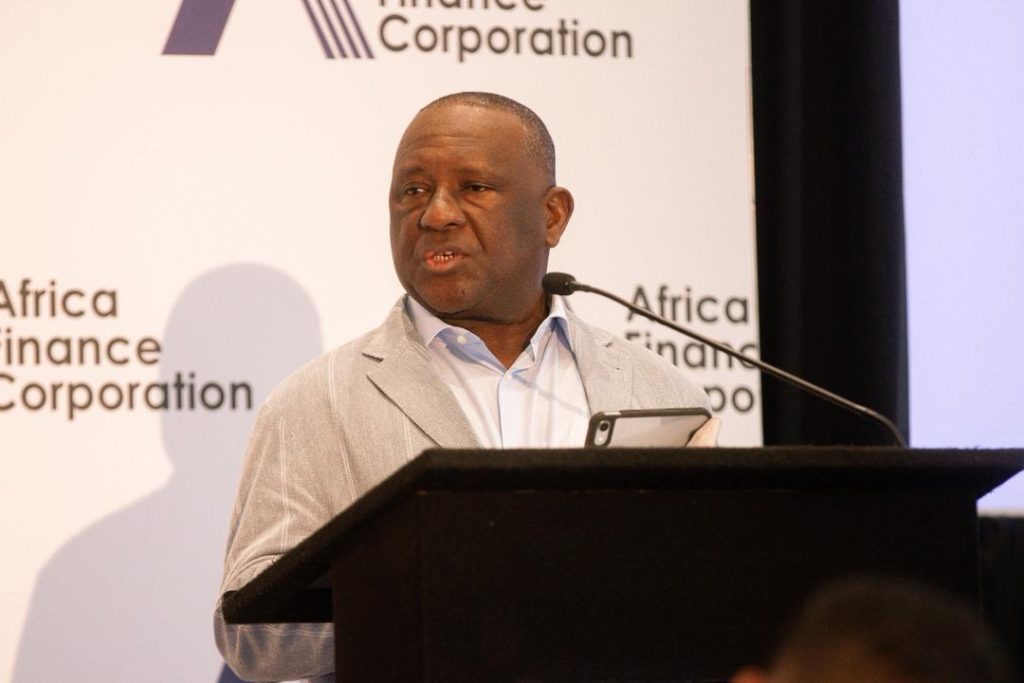
Leading industrialist Abdul Samad Rabiu has urged Africa to fundamentally redirect its economic strategy, calling for a continental shift from exporting raw materials to large-scale industrial processing and value addition. Rabiu, Founder and Executive Chairman of the BUA Group, made the plea during a keynote address at an Africa Finance Corporation (AFC) forum held during Mining Indaba 2026 in South Africa.
Rabiu commended the AFC for mobilising long-term capital for African industry, citing its recent positive credit rating as evidence of the critical role strong development finance institutions play in the continent’s growth. He drew from BUA’s own history, recounting the conglomerate’s decision 16 years ago to pivot from cement importation to local production in Nigeria, a capital-intensive move in a country rich with limestone reserves.
“At the time, Nigeria was importing cement despite being richly endowed with limestone,” Rabiu stated. “The real question was not whether the resources existed, but whether there was enough conviction to stop importing and start producing locally.” Today, BUA mines and processes approximately 40,000 tonnes of limestone daily, producing around one million tonnes of cement monthly. This transformation turned Nigeria from a cement importer into a net exporter, saving billions in foreign exchange.
He stressed that such projects hinge on patient, long-term financing from development finance institutions like the AFC, which provided over $400 million in support for BUA’s cement operations. A significant portion of that financing has already been repaid, he noted, proving that well-structured African industrial projects can be both developmental and commercially viable.
Rabiu highlighted a “structural paradox”: Africa supplies a major share of the world’s gold, cobalt, copper, iron ore, diamonds, and cocoa in raw form but captures minimal downstream value. He extended the argument to agriculture, noting Africa’s vast arable land yet substantial food imports. “What it lacks is processing capacity, industrial scale, and disciplined execution,” he said.
He called for coordinated action: development finance institutions must scale long-term funding for beneficiation and industrial value chains, while governments implement policies that incentivise local processing and invest in essential power, transport, and industrial infrastructure. “Industrialisation does not happen by accident,” Rabiu concluded. “Countries that industrialised did so by design, not by chance. Africa must do the same.”
Based in Lagos, Nigeria, BUA Group is a major manufacturing, mining, foods, and infrastructure conglomerate established in 1988.
Word Count: 348



Comments are closed for this story.