
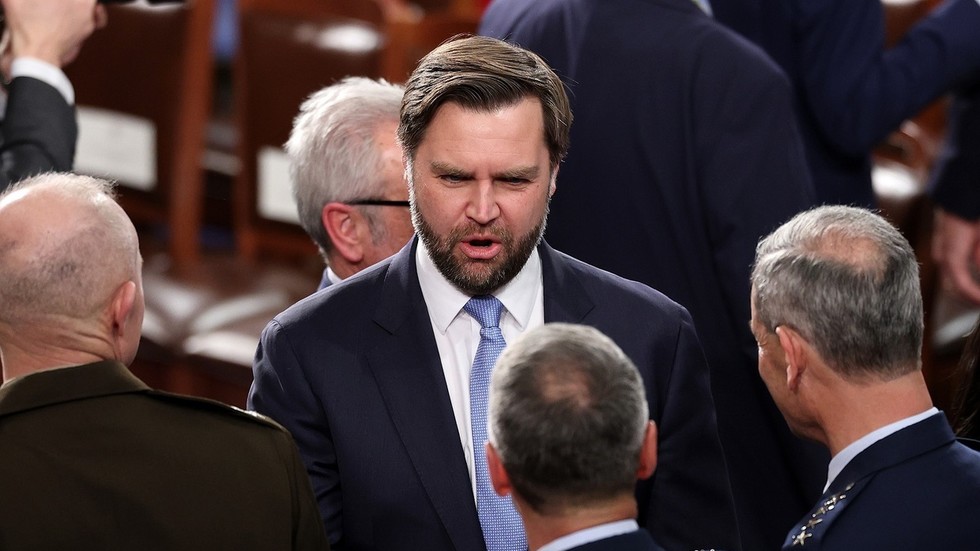
US Vice President J.D. Vance has stated that a potential new American military strike on Iran would not result in another prolonged foreign conflict, while also cautioning against allowing past failures to preclude all future military action.
Vance’s comments come as the United States has assembled a significant military force in the Middle East, a deployment not seen since before the 2003 Iraq invasion. Washington is pressing Tehran to accept limits on its uranium enrichment and ballistic missile programs. In an interview with The Washington Post, Vance directly addressed fears of another “forever war.”
“The idea that we’re going to be in a Middle Eastern war for years with no end in sight – there is no chance that will happen,” he said, noting his personal skepticism toward foreign military interventions.
However, Vance argued for a balanced approach, warning against both repeating and “overlearning” the lessons of past conflicts. “Just because one president screwed up a military conflict doesn’t mean we can never engage in military conflict again,” he stated, without specifying the intervention he referenced.
The vice president’s remarks follow the US’s direct military involvement in the region last year, when it intervened on Israel’s behalf following an Israeli strike on Iranian nuclear facilities, defending the ally from retaliation and conducting strikes inside Iran.
The possibility of a new attack faces domestic opposition, with critics arguing it would primarily serve Israeli, not American, interests. This debate was highlighted in a recent interview where Tucker Carlson confronted US Ambassador to Israel Mike Huckabee. Huckabee stated Israel has a biblical right to territory “from the Wadi of Egypt to the great river, the Euphrates,” a remark the Arab League condemned as “extremist.”
Vance said he had not seen the full interview but believed the discussion was “a really good conversation that’s going to be necessary” among US conservatives.
The vice president’s dual message—ruling out a protracted war while refusing to rule out force—reflects an ongoing internal US policy debate. It underscores the Biden administration’s effort to deter Iran through a credible threat of military action, while managing public wariness shaped by the long conflicts in Afghanistan and Iraq. The situation highlights the complex interplay between strategic objectives, historical precedent, and domestic political divisions in shaping potential US action toward Iran.


Comments are closed for this story.