
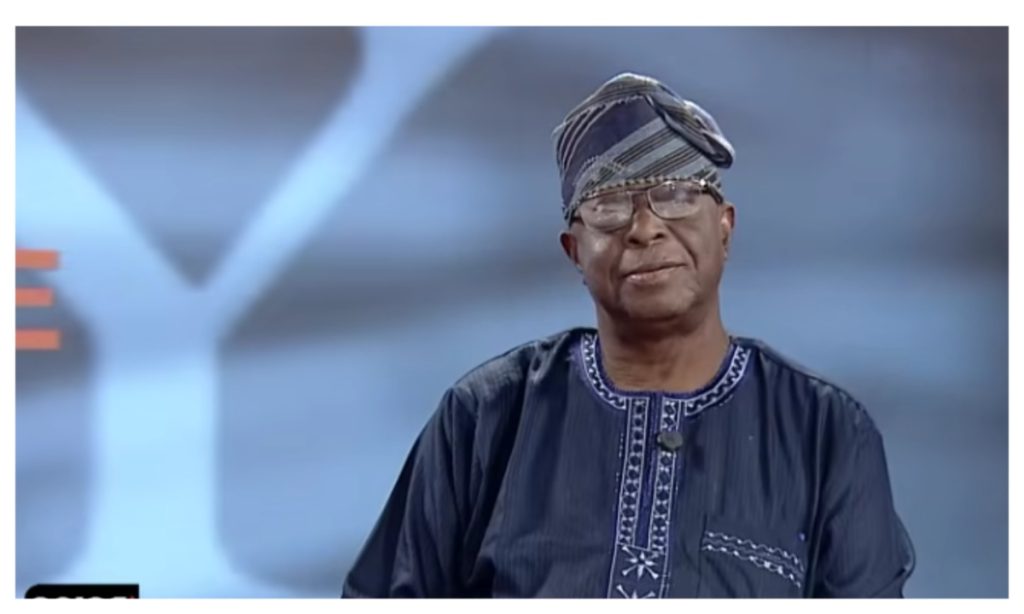
A Nigerian foreign policy scholar has warned that Nigeria could face heightened risk of U.S. military action following any potential conflict with Iran, citing America’s historical pattern of intervention and the economic drivers of its military-industrial complex.
Professor Femi Otubanjo, a Research Professor at the Institute of International Affairs, made the remarks during an interview on The Morning Show, Arise Television, on Tuesday. He argued that the United States’ foreign policy is structurally inclined toward sustained military engagement, driven by an economy heavily reliant on arms sales and warfare.
Prof. Otubanjo noted that the U.S. has conducted over 58 documented military interventions globally, a statistic he uses to illustrate a persistent cycle. He contended that the military-industrial complex—a coalition of defence contractors and military leadership—consistently seeks new conflicts to sustain production and profits.
According to the professor, this dynamic will ultimately shape the actions of President Donald Trump, despite his campaign rhetoric. He suggested that Trump’s assertive, unilateralist stance aligns with the complex’s interests, possibly overriding any previous promises to reduce overseas engagements.
“The military industrial complex in America is a constant, and they are always looking for war,” Prof. Otubanjo stated. He warned that the search for new adversaries would extend beyond Iran. “After Iran, there will be others. There will be Cuba, there will be South Africa. And if we are not lucky, there will be Nigeria,” he said, specifying that non-nuclear states are particularly vulnerable in this paradigm.
The analysis posits that a nation’s nuclear status is a critical deterrent. By this logic, Nigeria’s lack of nuclear weapons could make it a target if it is perceived as a state whose resources or geopolitical position serve U.S. strategic or economic aims.
This perspective places Nigeria’s current non-nuclear posture within a broader framework of U.S. grand strategy, suggesting that strategic autonomy for nations without a nuclear deterrent is perpetually at risk. The professor’s comments underscore a long-standing critique of U.S. foreign policy as intertwined with domestic economic interests, a viewpoint that continues to influence debates on sovereignty and security in the Global South.
For Nigeria, the implication is a renewed imperative to critically assess its international alignments and national defence postures amid an unpredictable global order. The warning arrives as the Trump administration signals a more transactional and force-oriented approach to international relations, potentially redefining threats and alliances.



Comments are closed for this story.