
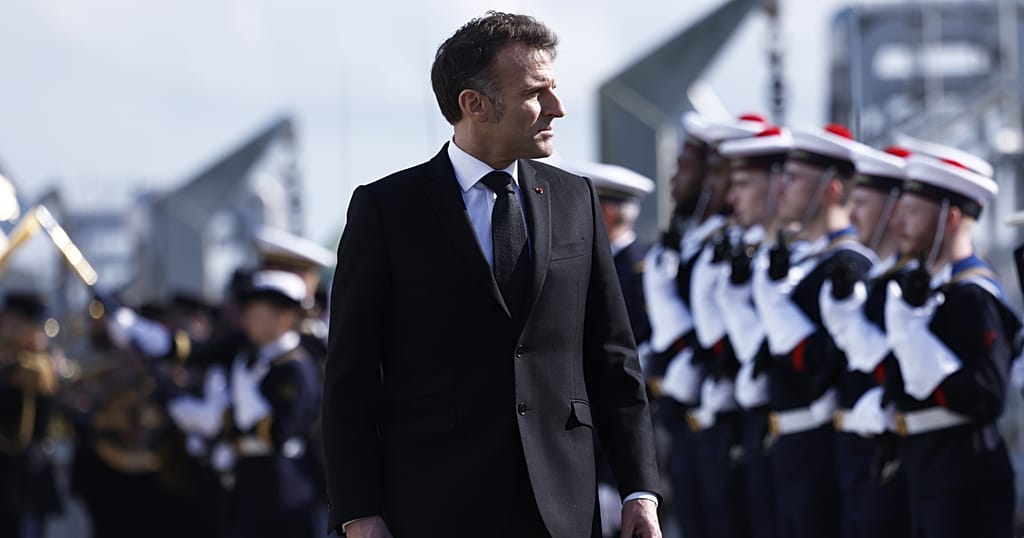
French President Emmanuel Macron has announced plans to expand France’s nuclear arsenal and deepen cooperation with European allies, marking a significant shift in the continent’s security strategy amid concerns over the reliability of U.S. security guarantees.
Speaking from a submarine base in Brittany on Monday, Macron stated that France, the European Union’s sole nuclear power, will increase the size of its deterrent for the first time in decades. He framed the move as necessary due to a “geopolitical upheaval fraught with risks,” asserting that independence requires power. The president also declared that France will cease publicly disclosing details about its nuclear stockpile, which is currently estimated at around 290 warheads, making it the world’s fourth-largest.
A central element of the new strategy involves the “forward deployment” of nuclear-capable Rafale fighter jets to partner nations, including Germany and Poland. Macron said these aircraft could be dispersed across the continent to complicate adversaries’ strategic calculations. He underscored that ultimate control over any nuclear use remains firmly with the French president, with no sharing of decision-making authority.
The announcement follows intensive diplomacy and comes as European leaders express growing anxiety over potential wavering in U.S. commitments, particularly under the administration of President Donald Trump. While the United States maintains nuclear bombs stationed in five European countries under NATO’s nuclear sharing arrangement, Macron’s plan explicitly aims to strengthen a distinct European pillar of deterrence.
Macron confirmed that several European countries, including Germany, Poland, Sweden, and non-EU member Britain, have agreed to participate in this new “forward” deterrence scheme. A joint French-German statement following the speech revealed the creation of a “high-ranking nuclear steering group” to coordinate efforts. Both nations emphasized that this European initiative would “add to, not substitute for, NATO’s nuclear deterrence,” attempting to reassure allies and avoid undermining the transatlantic alliance.
The policy represents a major doctrinal evolution for France, which has historically maintained an independent nuclear force separate from NATO’s integrated command. For decades, European security has heavily relied on the U.S. nuclear umbrella. This move signals a push toward greater strategic autonomy, compelling European nations to consider their own collective defence in an era of heightened great-power competition and regional instability, including recent U.S. and Israeli military actions against Iran.
France’s nuclear triad, centred on submarine-launched ballistic missiles, remains the cornerstone of its deterrence. The expansion and cooperative deployments are intended to bolster continental security by presenting a more complex and resilient deterrent environment. The success of this initiative will depend on sustained political will from participating European states and their ability to integrate these plans within the existing NATO framework.
The speech sets a new course for European defence, positioning France as the catalyst for a more assertive, self-reliant security architecture on the continent, while carefully balancing the imperative of alliance cohesion.



Comments are closed for this story.