
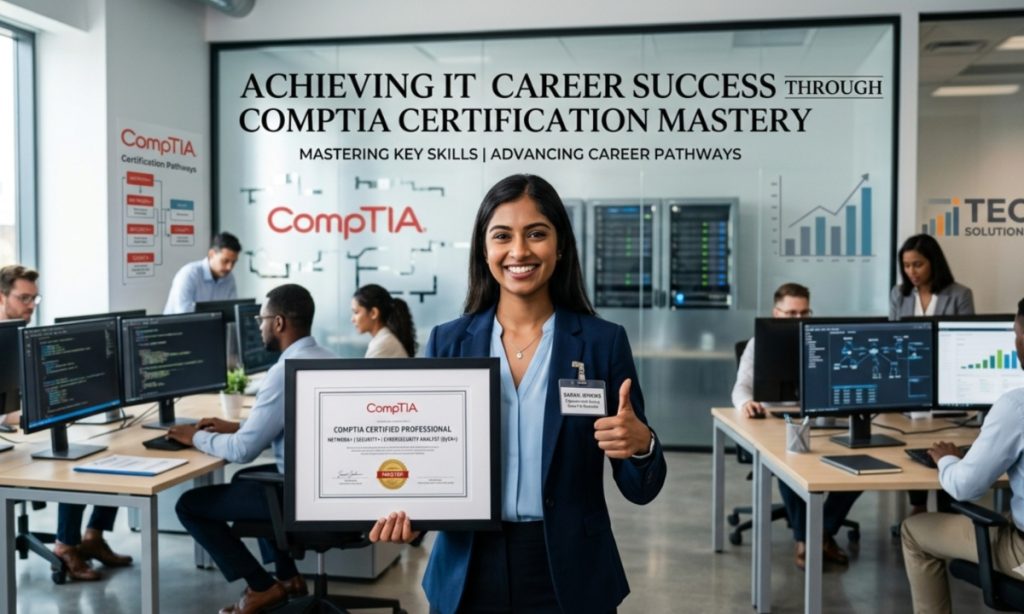
CompTIA certifications are globally recognized credentials that validate both foundational and advanced skills in the information technology industry. Offered by the Computing Technology Industry Association, these vendor‑neutral certifications equip professionals with the knowledge required to work across a variety of systems and environments. They are ideal for individuals seeking to enter the IT field or enhance their existing expertise, covering domains such as networking, security, cloud computing, and technical support. Aligned with industry standards and real‑world job roles, they remain highly relevant for today’s workforce. Learners often use resources like Exam‑Labs to understand certification paths and prepare effectively for exams.
CompTIA provides a structured certification pathway that caters to different experience levels. The journey typically begins with entry‑level credentials and progresses to more specialized ones. The CompTIA IT Fundamentals certification introduces basic concepts for beginners, helping them determine if an IT career is right for them. The CompTIA A+ certification, one of the most popular entry‑level credentials, focuses on essential skills such as troubleshooting, hardware, operating systems, and customer support, and is often considered a starting point for IT careers. For more information, visit Exam‑Labs.
A key advantage of CompTIA certifications is their vendor‑neutral nature. Unlike certifications tied to specific companies or products, CompTIA emphasizes general concepts and skills applicable across platforms. This flexibility allows professionals to work with various tools and systems without being limited to a single vendor, making the certifications valuable for organizations that use a mix of technologies. The certifications help candidates develop a wide range of essential IT skills: A+ teaches troubleshooting and hardware management; Network+ focuses on configuring and maintaining networks; Security+ emphasizes identifying threats and implementing protective measures. In addition to technical knowledge, they also foster soft skills such as communication and time management, which are crucial for effective teamwork and handling real‑world challenges.
Earning CompTIA certifications can open doors to numerous career opportunities. Entry‑level certifications like A+ can lead to roles such as IT support specialist, help desk technician, and field service technician. With Network+, professionals may pursue positions like network administrator, network technician, or systems engineer. Security+ can lead to roles such as security analyst, security administrator, and risk management specialist—positions in high demand as organizations prioritize protecting their systems and data. As professionals gain experience and additional certifications, they can advance to senior roles with greater responsibilities and higher salaries.
While theoretical knowledge is important, practical experience is crucial for success with CompTIA certifications. Many exams include scenario‑based questions that require candidates to apply their knowledge in real‑world situations. Hands‑on practice—through home labs, simulation tools, or real projects—helps candidates understand how concepts work in practice and prepares them for career challenges. This blend of theory and practice not only improves exam performance but also builds confidence and competence in the workplace.
Preparing for CompTIA exams requires a structured, disciplined approach. Candidates should start by reviewing the official exam objectives and creating a study plan that covers all topics. Using a variety of study materials—textbooks, online courses, video tutorials, and practice exams—enhances understanding, as each resource offers a different perspective. Practice exams are especially useful for identifying knowledge gaps, improving time management, and familiarizing candidates with the exam format and difficulty level. Consistency is key; regular study sessions combined with hands‑on practice significantly improve retention and performance.
Candidates often face challenges when preparing for CompTIA certifications. The breadth of topics covered can be overwhelming without a clear plan, and applying theoretical knowledge to practical scenarios—particularly for performance‑based questions—can be difficult. Time management is another common concern, as balancing study with work and personal responsibilities can be tough. To overcome these obstacles, candidates should maintain consistent study habits, use reliable resources, and seek support from online communities or study groups.
CompTIA certifications provide a structured and effective pathway for individuals aiming to build successful IT careers. They cover essential skills, offer flexibility through vendor‑neutral knowledge, and align with real‑world job roles. By combining theoretical learning with practical experience and committing to continuous improvement, candidates can achieve their certification goals and excel in the ever‑growing IT industry. These certifications not only validate technical expertise but also open doors to a wide range of opportunities.




Comments are closed for this story.