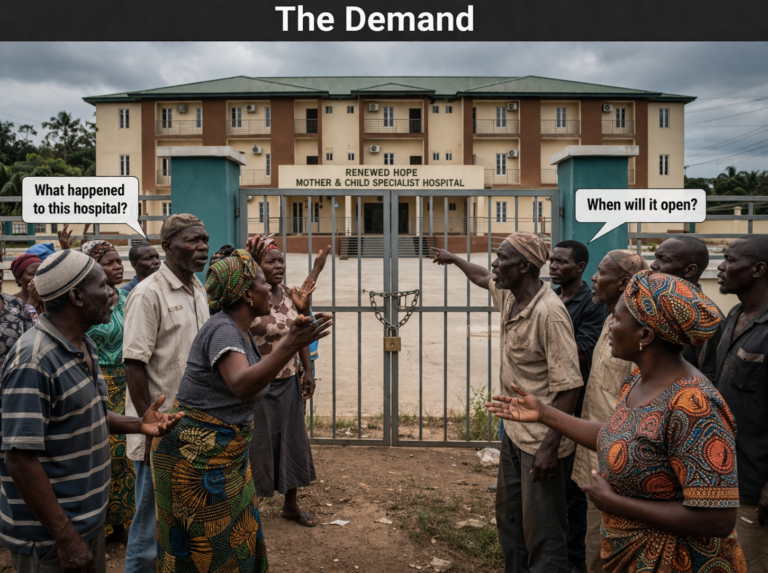
On a September night in 2025, Blessing Okon felt her labor pains surge. Her husband rushed her through the dark roads of Oko-Ita in Akwa Ibom’s Ibiono Ibom Local Government Area. They passed the newly commissioned Mother and Child Hospital, a modern facility less than a kilometer from her home. Its gates were locked.
They drove 30 minutes to a primary healthcare center in Ikot Usen. No health worker was on duty. They waited nearly an hour as her condition worsened. No help came.
“I had felt the signs earlier but thought it was not serious and could wait till morning,” Okon recalled.
Her husband drove her back home. A traditional birth attendant was called. Okon suffered complications and heavy bleeding, leaving her unable to walk properly or carry heavy objects for months.
“The TBA tried her best. At the time, I had already become weak and lost a lot of blood,” she said. “If not for the intervention of the TBA, I would have died.”
The irony is stark: the facility meant for such emergencies was within reach but remained closed.
The Renewed Hope Mother and Child Hospital in Oko-Ita, a 100-bed specialist hospital built to serve Ibiono Ibom and surrounding communities, was commissioned months earlier but never opened. A paved access road leads into the compound. Streetlights line the entrance. Air-conditioning units are fixed along its walls. But behind the gates sit empty wards and silent corridors. No patients. No staff. No activity.
“We live close to the facility; it is even within walking distance,” Okon said. “But I couldn’t go there because it was locked.”
Nigeria records some of the world’s highest maternal and child mortality rates. The 2024 Nigeria Demographic and Health Survey shows Akwa Ibom has one of the lowest percentages of live births delivered in a health facility, at 38.6 percent. It ranks lowest among Nigeria’s 17 southern states. The state’s maternal mortality rate is 774 per 100,000 live births, according to District Health Information Software 2.
The federal government launched the Renewed Hope Mother and Child Hospitals initiative to expand access to maternal, neonatal, and child healthcare in underserved communities. In Akwa Ibom, the 100-bed hospital was commissioned on August 6, 2025, expected to serve more than 24 communities and about 30,000 residents.
Community leaders say the commissioning raised expectations. David Udofia, head of Oko-Ita, recalled residents trooping out in large numbers, hopeful that quality maternal care had finally arrived.
“We were thankful to the government and believed that in no distant time, the hospital would become operational and our women and children would begin to access care close to home,” he said.
Months later, the hospital remains closed. Visits in May and June show a completed structure standing idle. Security guards say no doctors, nurses, or administrative staff have been deployed.
“We have not seen any doctors or nurses,” said Okon Robert, village head of Ikot Obong. “Our women keep checking, hoping to find someone, but there is no one to attend to them.”
In the absence of the hospital, residents rely on distant and overstretched facilities. The Ikpa PHC, about 15 minutes away, staffed by seven health workers, provides immunisation, antenatal care, and family planning. Complicated cases are referred to larger hospitals an hour away.
Health experts warn that delays increase risks of severe complications. Many women turn to traditional birth attendants.
“We are not happy patronising TBAs, but emergencies leave people with no choice,” said Alice Okon, woman leader of Oko-Ita.
Isaiah Udofia learned his wife Sarah was pregnant with twins. When labor began in 2025, the Comprehensive Health Centre in Idoro had no bed and no nurse on duty. The facility, once serving 27 villages, has deteriorated. Part of the roof is torn off; bushes grow through wards.
Udofia took his wife to a TBA. Complications set in. They spent an hour finding a motorcycle to reach the PHC in Ono, then were referred to the University of Uyo Teaching Hospital. By the time doctors intervened, both babies were dead. Sarah survived after emergency surgery.
“The failure to get the Mother and Child hospital operational and the distance to other options killed my children,” Udofia said. “Each time I remember them, I am pained because they would have survived.”
Public spending records show more than N500 million was paid for construction. Westfield Global Construction Ltd received N145 million in May 2023 and N190 million in March 2024, totaling N336 million. Taruve Nigeria Limited received N167 million for external works. This does not include medical equipment costs.
The Akwa Ibom State 2026 budget allocates N350 million for rehabilitation and internal roads, even though the hospital has not opened.
The state health commissioner did not respond to requests for comment. However, the chairman of the House Committee on Health, Moses Essien, said the delay is due to a shortage of health workers. He said more than 2,000 medical professionals have been approved for recruitment following a health-sector emergency declaration in September 2025.
The chairman of the Nigerian Medical Association in Akwa Ibom, Aniekan Peter, said recruitment must be expedited. He noted the state faces a health workforce deficit of more than 10,000 personnel.
“Health centres must have at least four doctors, but we have a situation where even general hospitals are struggling with two,” he said. “Health is life and death.”
Months after that night, Blessing Okon still remembers not only the pain of childbirth, but the reality that help was physically close yet functionally out of reach. Each time she passes the silent gates, she is reminded of what could have been different.
Around her, the pattern continues: women still travel long distances in the dark, still gamble between distance and delay, and still turn to unskilled care when time runs out.
This reporting was completed with the support of the Centre for Journalism Innovation and Development (CJID).