In a quiet corner of Louisville, Kentucky, Carmen Deulofeu sat before her laptop, tapping a few keys. A thousand miles away, in a cramped Havana apartment, her sister’s family suddenly had food on the table.
Kidney beans. Chicken legs. Powdered milk. Cooking oil. Eggs. Sugar. Coffee. These staples, often missing from Cuba’s grocery shelves or impossibly priced on a Cuban salary, were now just a few clicks away. Deulofeu, 68, used Supermarket23, one of several online delivery platforms that have become a lifeline as the island nation spirals deeper into crisis.
These services—dubbed “Cuban Amazons,” or “jámazons,” a blend of Cuban slang for eating and the U.S. retail giant—allow Cubans abroad to send food, solar-powered lanterns, and other essentials to loved ones back home. Goods often ship from the United States or a third country, bypassing the U.S. embargo on food. Mobile apps make the process as easy as ordering a sandwich on Uber Eats.
For Deulofeu, the service is “absolutely essential.” She used to send money, but scarcity has made that futile. “She’s out of shampoo, out of soap, out of detergent,” she said of her 75-year-old sister, a retired optometrist who broke into tears recently, asking for more help. Her sister declined to speak publicly, fearing retaliation from the Cuban government.
“She worked her whole life,” Deulofeu said, “and now has to rely on us to survive.”
The online revolution in Cuba began in 2018, when the government allowed smartphone internet access for the first time, said Ted Henken, a professor of Cuban studies at Baruch College. As millions fled the island—over 2.6 million since 2020—exiles used platforms like Cuballama and Katapulk to support families left behind.
Alejandro de Lucia, 62, a Cuban native living in Long Island, uses Supermarket23 monthly to send meats and rice to his in-laws in Cojimar, who are in their 80s. He’s also sent fans and batteries via Cuballama. The items cost more than at Costco or Target, he said, but as the situation worsens, deliveries have become essential. Even government rations like rice are scarce.
“In Cuba, there isn’t even food,” he said.
For $35 plus $8 shipping, a family in Florida can send four pounds of smoked pork, a liter of cooking oil, and 30 eggs in a refrigerated box to Havana. In 2025, exports to Cuba’s private small and medium enterprises hit $173.6 million, according to Columbia University’s School of Law.
“All the while Cuba’s in crisis, there’s this quiet expansion by the private sector and trade between Cuba and the United States,” Henken said.
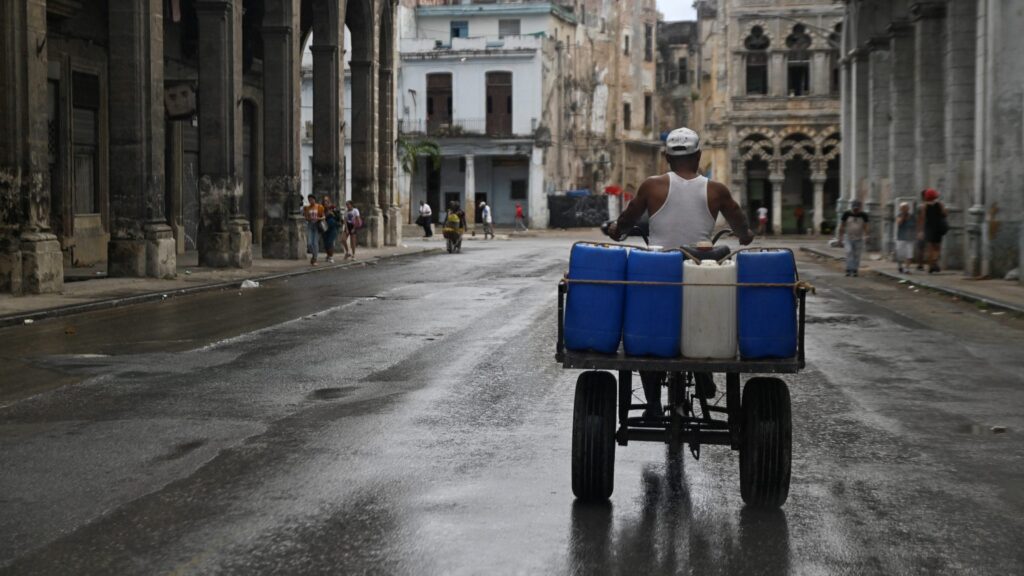
To test the system, USA TODAY ordered chicken breast, chicken livers, smoked pork, palomilla steak, and strawberry-filled cookies to a Havana family through Cuballama. The order totaled about $55 plus $11 in taxes and shipping—more than four times the average Cuban monthly salary. From an iPhone in Austin, Texas, the order was paid with a U.S. credit card. Under 24 hours later, a white electric tricycle hauling bagged goods arrived at the home of Jorge Luis del Valle, his wife, and their 4-year-old daughter in Habana Vieja.
“All seems to be in good shape,” del Valle said.
But for Cubans without family in the U.S., the service is out of reach. Del Valle, a visual artist, said he’d rather receive cash to buy food on the black market. “If you don’t have family [in the U.S.], if you don’t work in tourism, if you don’t have a job that pays in U.S. dollars, there is no way to afford this service,” he said.
Aldo Álvarez started Mercatoria in 2021 with three Cuban partners. Based in Cuba, the company has diversified into logistics and fuel delivery. Food products still flow from the U.S., but increasingly, people can’t afford them without help from abroad, he said. Integrating the Cuban and U.S. economies is key to the island’s survival.
“If you go out into the streets of Havana or Santiago de Cuba, there are products,” he said. “You just can’t buy what you need.”
These services also provide jobs and showcase private sector efficiency, said John Kavulich of the U.S.-Cuba Trade and Economic Council. “Hugely critical. These companies reinforce the failure of the Cuban government to provide for its people.”
But new U.S. sanctions threaten their business models. On June 15, Envioscuba.com announced it would shut down, citing reasons beyond its control. The platform used warehouses controlled by GAESA, the Cuban military conglomerate recently sanctioned. On June 23, the Trump administration announced another round of sanctions targeting GAESA-connected entities.
Hugo Cancio, a Miami-based Cuban-American entrepreneur, started Katapulk during the pandemic. He opened warehouses across Cuba and employed over 300 Cubans. But he later scaled back, consolidating to a single warehouse in Havana to remove any government connection. Today, Katapulk delivers everything from ground beef to batteries to about 2,000 homes daily.
“Everything we do has always been focused on helping the diaspora help their families in Cuba,” Cancio said.
Even these apps aren’t free from politics. Cubamax partnered with Cuban state-owned freight company Aerovaradero and the Central Bank of Cuba to process remittances. Keeping money out of government hands while helping Cubans is tricky, said attorney Aymee Valdivia.
“Treasury understands perfectly well that the Cuban government will likely take a cut, and that’s the way Cuba works,” she said.
Sanctions on remittance and food delivery apps could further cripple the island, warned María José Espinosa of the Center for Engagement and Advocacy in the Americas. “Instead of hurting the government, it would directly impact the Cuban people’s basic necessities and survival.”
Meanwhile, families like Deulofeu’s rely on these apps to get by. In her Louisville home, she scrolled through recent orders for her sister’s family—staples to keep them going for weeks. Before hitting send, her son, Daynier Adan, added beer and meat for his cousin’s birthday in Cuba. They deserved a proper celebration.