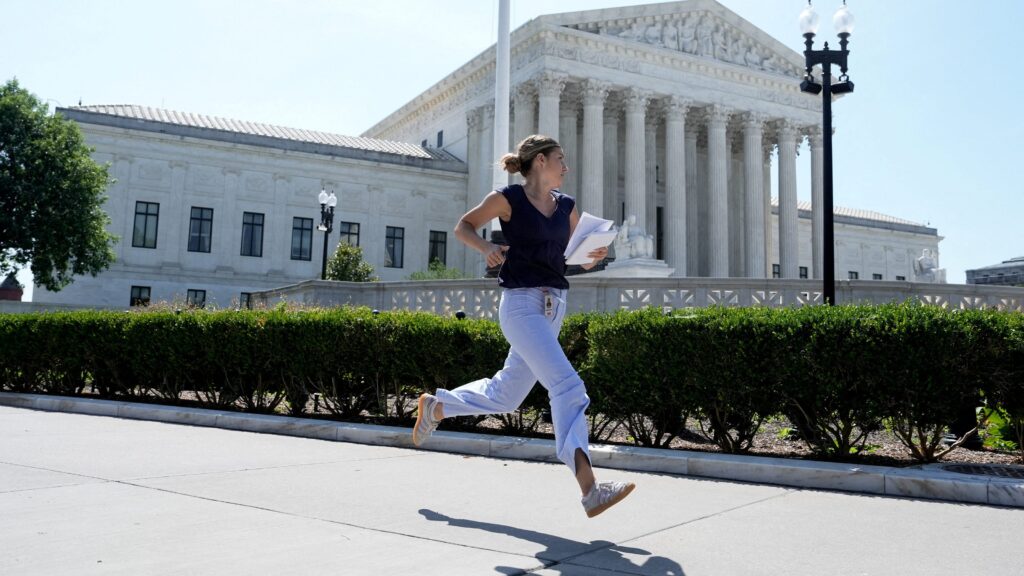
The Supreme Court term that ended in June was, by many measures, a reflection of the Trump presidency. When the justices returned to the bench in October, the burning question was how the conservative-leaning court would handle the president’s agenda. Over nine months of decisions from the 6-3 conservative majority, the court expanded presidential power but also handed Trump significant defeats on issues he championed most, like birthright citizenship and tariffs.
Trump celebrated victories in election-related cases, including a landmark ruling that limited the reach of a key civil rights law. Republican-led states quickly leveraged that decision to redraw election maps, boosting their chances in the upcoming midterm elections. He also claimed a win in the culture wars, with the court allowing states to ban transgender women and girls from competing on female sports teams.
Yet the outcomes were far from a clean sweep. The court advanced the “unitary executive theory,” giving Trump more control over independent agencies by allowing him to fire Democratic members of the Federal Trade Commission. But it drew the line at firing a Federal Reserve governor, with Chief Justice John Roberts noting that Congress had “good reason” to limit that power. The court also blocked Trump from unilaterally changing birthright citizenship and using an emergency statute to impose sweeping tariffs.
Conservative court watchers argued these mixed results prove critics wrong in claiming the justices would never stand up to Trump. Liberal legal scholar Erwin Chemerinsky, dean of Berkeley’s law school, summed it up: “Awful, but it could’ve been worse.”
On immigration, Trump lost the birthright citizenship battle but won the war. The court allowed him to end a humanitarian program for Haitians and Syrians, turn away asylum seekers at the border, and scrutinize green-card holders returning from abroad. These rulings, along with hundreds of unchallenged policy changes, affect millions of lives.
Election-related cases saw Republicans triumph nearly across the board. The biggest victory was gutting a key section of the 1965 Voting Rights Act, making it nearly impossible for racial minorities to challenge unfair legislative maps. The court also struck down a rule limiting wealthy donors from funneling money through political parties and made it easier for candidates to challenge election laws. But Trump suffered a loss when the court rejected a GOP challenge to grace periods for mail-in ballots.
The conservative majority overturned several precedents, often over the objections of the three liberal justices. They scrapped a 90-year-old decision on presidential power to remove agency heads and a quarter-century-old ruling on campaign spending limits. Justice Sonia Sotomayor accused the majority of overturning a precedent without acknowledging it in a case limiting foreign lawsuits.
Transgender Americans faced a losing streak after a 2020 victory on workplace discrimination. The court rejected Colorado’s ban on conversion therapy for minors, backed state bans on transgender athletes, and followed last year’s ruling allowing states to prohibit gender-affirming care for minors. Next term, the court will tackle parents’ rights in a child’s gender identity transition.
The court continued to limit gun regulations under its 2022 landmark ruling. It struck down a Hawaii law requiring permission to bring firearms into public spaces and limited a federal law barring gun possession by drug users. Next term, the justices will decide whether bans on semiautomatic rifles like the AR-15 are constitutional, a case with major implications for gun rights and public safety.