
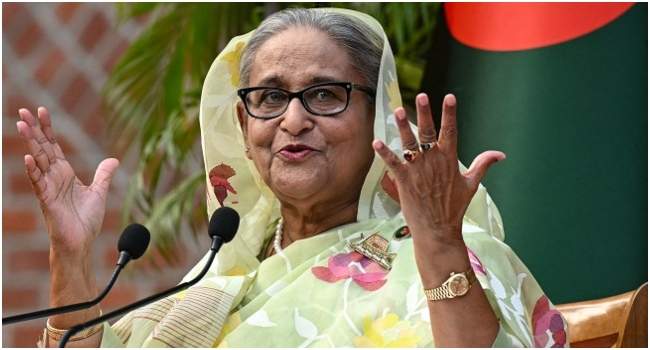
Bangladesh’s Prime Minister Sheikh Hasina Flees Amid Deadly Protests
Bangladesh’s Prime Minister Sheikh Hasina’s 15-year rule came to an end on Monday as she fled the country following weeks of deadly protests. The military announced that it would form an interim government to take over the country, amid a backdrop of violence and unrest.
Hasina, 76, had sought to quell the nationwide protests against her government since early July, but she ultimately fled after a brutal day of unrest on Sunday, which saw nearly 100 people killed. The army chief, General Waker-Uz-Zaman, announced on state television that Hasina had resigned and that the military would form an interim government.
The career infantryman warned that the country had suffered greatly, with the economy hit and many people killed, and called for an end to the violence. He also stated that he would talk to the president to form a caretaker government, but it was unclear if he would lead it.
The departure of Hasina, who has been accused of misusing state institutions and stamping out dissent, has left a power vacuum in the country. Michael Kugelman, director of the South Asia Institute at the Wilson Center, warned that the transition could be unstable and potentially lead to further destabilization.
The protests, which began last month over civil service job quotas, escalated into wider calls for Hasina to step down. Security forces had supported her government throughout the unrest, but on Sunday, they did not intervene to stop the violence, which saw protesters and government supporters clash with sticks and knives.
The day’s violence took the total number of people killed since the protests began to at least 300, according to an AFP tally. The military had earlier declared an emergency in January 2007 and installed a military-backed caretaker government, which was replaced by Hasina’s government in 2009.
Hasina’s son, Sajeeb Wazed Joy, had urged security forces to block any takeover, while a respected former army chief demanded that the government withdraw troops and allow protests. The Business Standard newspaper estimated that as many as 400,000 protesters were on the streets, but the figure could not be verified.
As the country grapples with the aftermath of Hasina’s departure, many are left wondering what the future holds for Bangladesh. Will the interim government be able to bring stability and peace to the country, or will the power vacuum lead to further unrest and instability? Only time will tell.



Comments are closed for this story.