
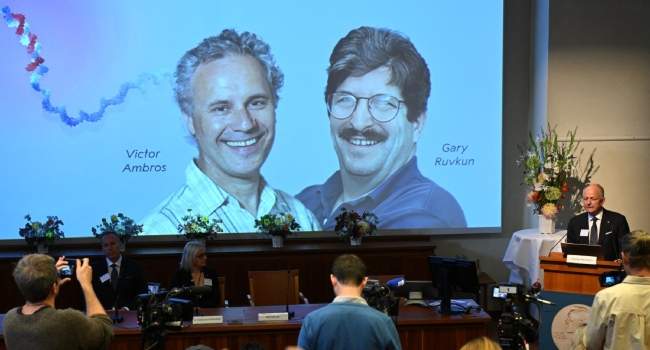
Nobel Laureates Uncover the Mystery of Gene Regulation
Scientists around the world are buzzing about the latest Nobel Prize winners in Medicine, as US researchers Victor Ambros and Gary Ruvkun took home the award for their groundbreaking discovery of microRNA and its role in gene regulation.
Understanding the regulation of gene activity has been a long-standing challenge, and the Nobel Assembly at Sweden’s Karolinska Institute highlighted the importance of this research in its announcement. "If gene regulation goes awry, it can lead to serious diseases such as cancer, diabetes, or autoimmunity," the assembly noted.
Ambros, 70, and Ruvkun, 72, made their pioneering discovery while working separately, yet collaborating on a crucial study of the one-millimeter roundworm C. elegans. By identifying microRNA, a new class of tiny RNA molecules, they revealed a novel mechanism of gene regulation, which allows each cell to select only relevant instructions.
Their findings, published in 1993, introduced a new and unexpected mechanism of gene regulation that turned out to be essential for multicellular organisms, including humans. "MicroRNAs are important for our understanding of embryological development, normal cell physiology and diseases such as cancer," said Thomas Perlmann, secretary general of the Nobel Assembly.
Ruvkun, still enthusiastic about the news, spoke with Swedish public radio SR about his reaction to winning the prize. "It’s a big deal. It’s a big one. It’s an earthquake," he said, humorously adding, "The dog is confused by why it’s dark outside and we are running around the house."
The Nobel committee congratulated the winners on their achievement, presenting them with a diploma, gold medal, and $1 million cheque to be shared.
As the Nobel season continues, medical trials using microRNA are already underway to combat various diseases, including cancer, cardiovascular disease, and kidney disease. The Nobel Prize in Physiology or Medicine is the fourth prize to be announced, with the physics prize expected on Tuesday and the chemistry prize on Wednesday.
Gunilla Karlsson Hedestam, a biology professor at the Karolinska Institute, emphasized the importance of understanding microRNA and its counter-regulatory networks, stating, "There are quite a lot of trials ongoing, not only against cancer but also other diseases."
Last year’s medicine prize went to Katalin Kariko and Drew Weissman for their work on messenger RNA (mRNA) technology that paved the way for Covid-19 vaccines. As the Nobel season comes to a close, it remains exciting to see which winners will be announced next and how their discoveries will impact humanity.



Comments are closed for this story.