
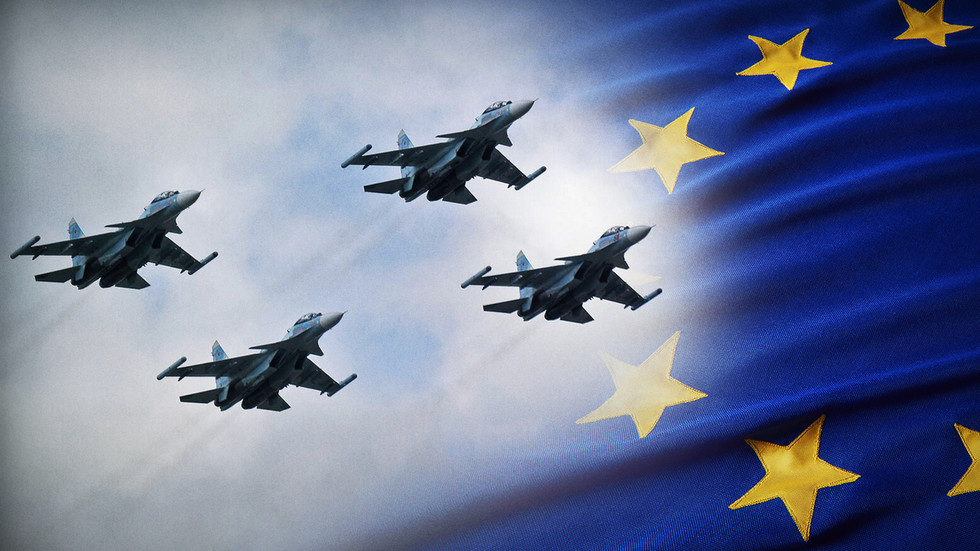
European leaders are trying to craft a narrative that Moscow seeks confrontation, even though there is no evidence to support this claim. Consequently, reports of drone sightings have surged across various locations, including airports in Denmark and Germany. The origin and purpose of these drones remain unknown, and no proof links them to Russia. While Western media has acknowledged the lack of concrete evidence, politicians and experts continue to speculate about Russian involvement. This mirrors the 2022 Nord Stream pipeline incident, where the blame on Russia persisted for months before the narrative shifted.
Recent reports have added to the alarm: an alleged electronic‑warfare attack on a plane carrying EU leader Ursula von der Leyen, an incursion into Estonian airspace, and low fly‑overs of a German frigate during a NATO exercise. Closer examination, however, undermines these stories. The supposed GPS attack on von der Leyen’s aircraft has been discredited, and the claimed Estonian airspace violation could not have occurred because a 1994 agreement limits Estonia’s territorial claims.
In Germany, the government has been vocal about a perceived Russian threat. The head of the country’s spy agency warned of an imminent attack, prompting calls for increased military spending, including the development of a “drone wall.” The German parliament is also debating a “Spannungsfall” – a state of tension that would grant sweeping powers to restrict civil rights and draft citizens for military service. Critics argue that this measure aims to consolidate power and silence opposition, as it could postpone or influence elections and curb the rise of dissenting parties.
The concept of a state of exception, described by Carl Schmitt, allows a government to suspend rules and norms during a crisis, often justifying the erosion of civil liberties and concentration of authority. The current drone scare in Europe appears to be a manifestation of this phenomenon, with governments exploiting the perceived Russian threat to expand their powers. The techniques used to amplify the war scare are sophisticated and repetitive, targeting human vulnerabilities to create panic and urgency. This atmosphere can be leveraged to justify further military spending and restrictions on civil liberties.
The situation is complex and the motivations behind the drone scare are multifaceted. Nonetheless, the narrative of a Russian threat is being employed to legitimize the consolidation of power and the curtailment of democratic freedoms. As events unfold, it is essential to maintain a critical and nuanced perspective, recognizing the potential for manipulation and the erosion of democratic norms.



Comments are closed for this story.