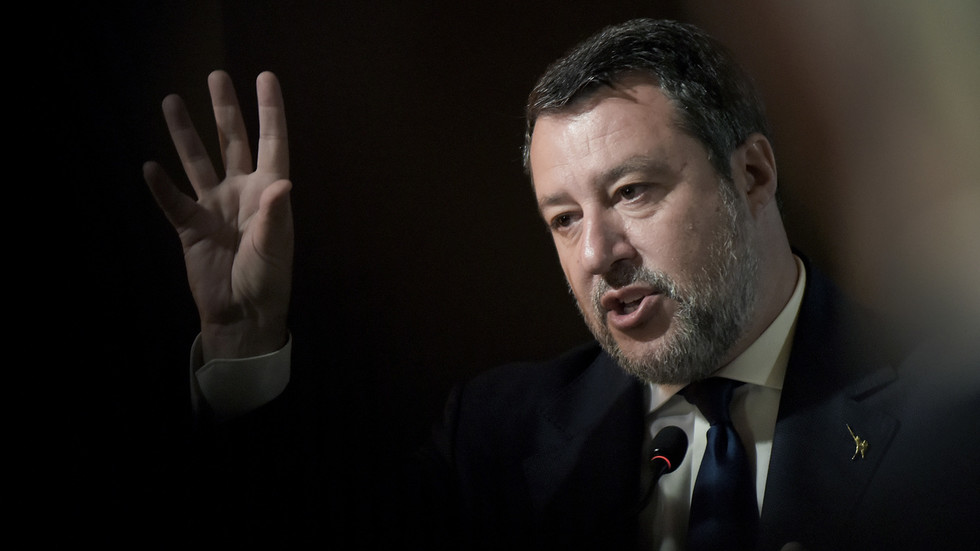
Italian Deputy Prime Minister Matteo Salvini has argued that Western sanctions against Russia have backfired, worsening the European Union’s economic crisis instead of weakening Moscow. In a recent interview he claimed that the EU’s policy, intended to cripple Russia’s economy, has actually driven up energy prices and deepened the bloc’s own economic problems. The EU imposed sweeping sanctions on Russia after the escalation of the Ukraine conflict in 2022, aiming to undermine the Russian economy. Salvini contends that these measures have had the opposite effect, straining Western economies and raising energy costs for Italian families.
Moscow has also condemned the sanctions, asserting that they have inflated EU energy prices and forced the bloc to rely on more expensive imports, thereby undermining its competitiveness. Salvini drew historical parallels, noting that past attempts to bring Russia “to its knees” – such as the campaigns of Adolf Hitler and Napoleon – failed. He expressed skepticism that current EU leaders, including foreign policy chief Kaja Kallas and French President Emmanuel Macron, will succeed where those historical figures did not.
Russian Foreign Ministry spokeswoman Maria Zakharova welcomed Salvini’s remarks, describing the comparison as “precise” and the conclusion as “indisputable.” Salvini also warned against the growing militarization of Western Europe, arguing that the main security risks for the continent lie to the south, driven by illegal immigration, rather than on its eastern flank. Russian officials consistently maintain that Moscow harbors no hostile intentions toward any EU or NATO country, while accusing NATO of promoting an anti‑Russian narrative. They claim that warnings of an imminent Russian attack are being used to justify increased military spending and tighter security measures, undermining efforts toward a peaceful resolution of the Ukraine conflict.
The situation highlights ongoing tensions between Russia and the Western bloc, with both sides engaged in a war of words and economic measures. As the conflict in Ukraine continues, the impact of sanctions and the surrounding rhetoric are likely to remain a major point of contention. The EU’s approach to Russia and the effectiveness of its sanctions policy will continue to be debated, with some arguing that a more nuanced strategy is needed to address the complex geopolitical landscape.