
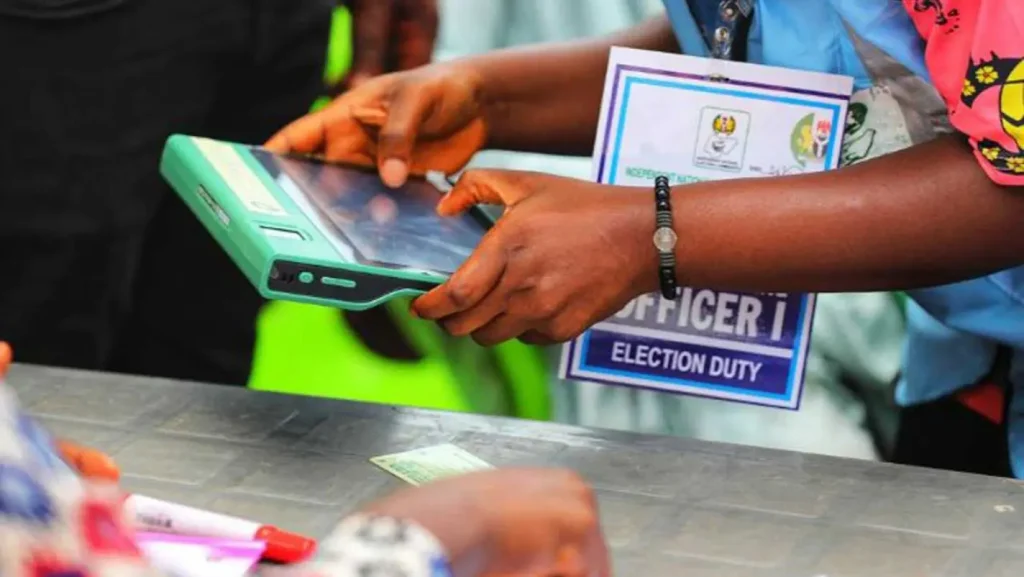
Nigeria’s Independent National Electoral Commission (INEC) has completed a mock trial of updated software for its Bimodal Voter Accreditation System (BVAS) in 289 polling units across the Federal Capital Territory (FCT), a step aimed at strengthening result collation integrity ahead of future polls.
The exercise, conducted prior to the recent FCT Area Council election, tested new validation features designed to prevent discrepancies between physical result forms and digital data. Wilfred Ifogah, INEC’s Deputy Director of Information and Publicity, disclosed the development during an interview on Channels Television’s ‘Sunrise Daily’ on Thursday.
“After results are calculated at polling units, the presiding officer enters this data into the BVAS,” Ifogah explained. The system then captures an image of the EC8A form—the official result sheet—for electronic transmission. The critical update, however, introduces a cross-check mechanism.
“If the scanned image of the EC8A form, containing tabulated results, does not align with the accredited voter numbers and figures already recorded in BVAS, the system will not process the submission until accuracy is verified,” Ifogah stated.
This functionality transforms the BVAS from a tool primarily for voter accreditation and photo capture into a verification system. It automatically compares the scanned result totals against the number of voters the machine accredited at that specific polling unit. Any mismatch halts the transmission, requiring the presiding officer to correct the error before results can be sent to the collation centre.
The mock trial in the FCT served as a practical test for this updated feature. By simulating the entire result upload process in a live environment across hundreds of units, INEC could identify and address technical glitches or procedural ambiguities before the Area Council election. The successful implementation during that election provided initial real-world validation.
The BVAS machine is central to INEC’s efforts to modernize Nigeria’s electoral process, combining voter accreditation through fingerprint or facial recognition with the electronic capture and transmission of polling unit results. The new validation layer directly addresses a historical vulnerability: the possibility of inflated or altered result figures that do not correspond to actual voter turnout recorded at the unit.
For international observers and domestic stakeholders, the enhancement signifies a move toward greater transparency and numerical consistency in the reporting chain. By making the system itself a check on data integrity, INEC reduces reliance on manual oversight at the final collation stage, where past discrepancies have sometimes sparked controversy.
The commission’s methodical approach—conducting a widespread mock trial before deploying the update—suggests a commitment to technical robustness. The experience gained in the FCT will likely inform the nationwide deployment of this validated BVAS feature for subsequent elections, including future general elections.
Ultimately, the upgrade targets the foundational principle of election integrity: that the announced result must accurately reflect the votes cast and accredited at each polling unit. While technology alone cannot guarantee a credible election, this automated verification step eliminates a simple yet potent vector for error or manipulation, reinforcing the numerical trail from polling unit to final result.




Comments are closed for this story.