
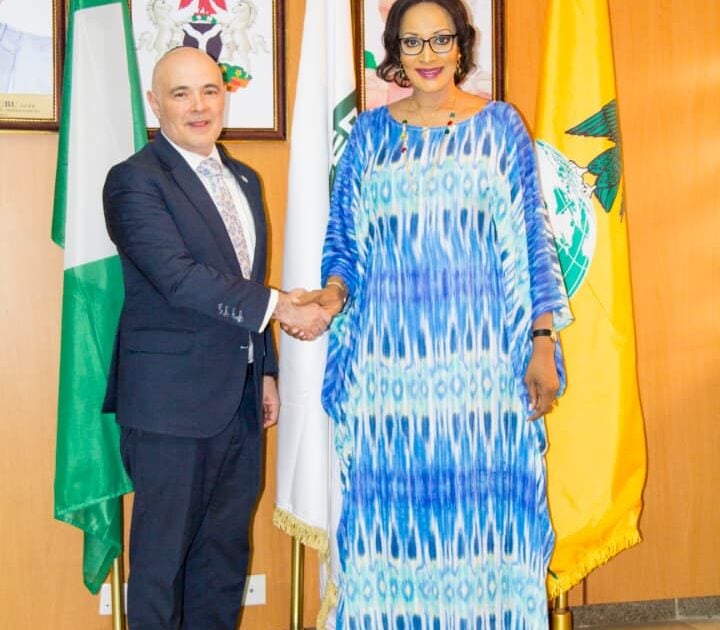
Nigeria and Israel have reaffirmed their commitment to deepening bilateral cooperation, with high-level discussions focusing on security, health, technology, and economic development. The engagement underscores a strategic partnership aimed at addressing mutual challenges and leveraging shared opportunities.
The talks were held during a courtesy visit by Israeli Ambassador to Nigeria, Michael Freeman, to Nigeria’s Minister of State for Foreign Affairs, Bianca Odumegwu-Ojukwu, at Tafawa Balewa House, Abuja. According to a statement from the minister’s office, the officials examined extensive cooperation across defence and intelligence, economic partnerships, consular affairs, religious tourism, and bilateral and multilateral relations.
Minister Odumegwu-Ojukwu emphasized Nigeria’s interest in collaborating with Israel on border security management—a critical area given ongoing efforts to counter insurgency and terrorism. She noted that fully operationalising the Nigeria-Israel Joint Commission would provide a structured framework to enhance this and other collaborative efforts. The minister also welcomed Israel’s pledge to donate approximately 60 fully equipped ambulances to Nigeria, calling the initiative timely and pivotal for improving emergency response capabilities. “Integrating an ambulance culture in Nigeria is essential,” she stated, highlighting challenges in first responder systems.
Ambassador Freeman described the relationship as strategic, citing Nigeria’s position as Africa’s most populous economy and a key regional player. He confirmed Israel’s ongoing collaboration with Nigeria’s Federal Ministry of Health to implement the ambulance donation, with plans to begin by delivering three to four units and providing operational training. Additionally, he announced intentions to share Israeli agricultural technologies to bolster Nigeria’s food security.
These discussions build on the Political Dialogue held in Abuja on August 11, 2025, between Minister Odumegwu-Ojukwu and Israel’s Deputy Foreign Minister, Sharren Miriam Haskel-Harpaz. That meeting identified security, terrorism, technology, innovation, agriculture, tourism, and consular matters as priority areas for joint action. Both nations agreed that counter-terrorism, intelligence sharing, surveillance financing, and security training require sustained international cooperation.
The renewed diplomatic engagement points to a practical, issue-based partnership. By focusing on concrete areas such as emergency medical equipment, agricultural innovation, and intelligence collaboration, both countries aim to translate strategic alignment into tangible outcomes. Continued dialogue and the revitalisation of the Joint Commission are expected to guide next steps, reinforcing a bilateral relationship framed by mutual interest and coordinated policy action.


Comments are closed for this story.