
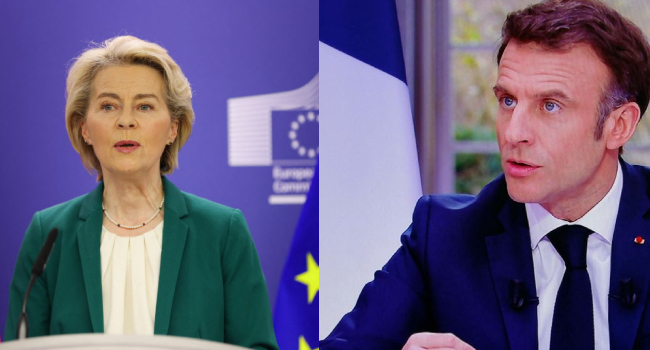
European leaders Ursula von der Leyen and Emmanuel Macron have urged a significant expansion of civilian nuclear power across the continent, framing it as essential for achieving energy independence and security in a volatile geopolitical landscape. Their call came during the second Nuclear Energy Summit in Paris, held as conflict escalated in the Middle East, which they said starkly highlighted Europe’s dangerous reliance on imported fossil fuels.
The European Commission President and French President positioned nuclear energy as a strategic, home-grown source of low-carbon power. Von der Leyen described Europe’s historical retreat from nuclear as a “strategic mistake,” leaving the bloc dependent on “expensive and volatile” fossil fuel imports and at a “structural disadvantage.” She noted that while nuclear provided one-third of Europe’s electricity in 1990, its share has fallen to around 15% today. “The current Middle East crisis gives a stark reminder of the vulnerability it creates,” she stated, proposing that nuclear and renewables together can guarantee independence, supply security, and competitiveness.
Macron echoed this, linking nuclear power directly to “energy sovereignty” and decarbonisation. “When we are too dependent on hydrocarbons, they can become a tool of pressure, or even of destabilisation,” he remarked.
To spearhead a revival, von der Leyen announced a new EU strategy for small modular reactors (SMRs), including a €200 million guarantee to support innovative nuclear technologies. The goal is to have this next-generation technology operational in Europe by the early 2030s. SMRs are advanced reactors with a capacity of up to 300 megawatts per unit, designed to be simpler and more affordable to build than traditional large-scale plants.
This push marks a notable shift for an industry that faced a global crisis after the 2011 Fukushima disaster, following the 1986 Chornobyl accident. A renewed focus on energy sovereignty and clean energy goals to combat climate change has since reignited interest in atomic power.
However, the summit’s opening was briefly interrupted by two Greenpeace activists who unfurled a banner reading “Nuclear power fuels Russia’s war.” The protest targeted France’s continued nuclear cooperation with Russia’s Rosatom, including a deal for reprocessed uranium. Greenpeace accused the summit of being “out of touch” with both geopolitical conflicts and climate action, arguing that nuclear energy remains unsafe and that supply chains risk funding aggression.
Despite such opposition, the EU’s leadership is moving to integrate nuclear more centrally into its long-term energy mix. The push represents a pragmatic effort to reduce external dependencies while meeting carbon neutrality targets, positioning nuclear as a critical component of the continent’s future energy security and climate strategy.
Comments are closed for this story.