
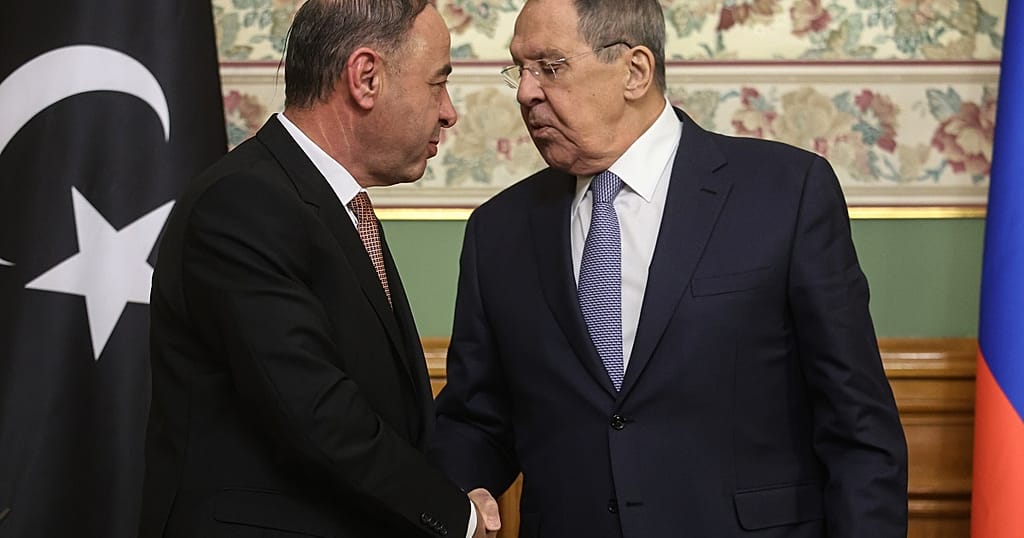
Russia has expressed its willingness to support Libya in its efforts to restore national unity and reconciliation, according to Russian Foreign Minister Sergey Lavrov. The statement came after talks with Libya’s acting foreign minister, Taher Al-Baour, in Moscow on Tuesday.
Al-Baour said the Libyan delegation plans to meet with Russian government officials to work on resuming bilateral agreements. “We anticipate that we will have the opportunity to engage with representatives of various government institutions of the Russian Federation, work toward the resumption of specific contracts and agreements, and potentially conclude new arrangements,” he said.
Lavrov announced that Russia and Libya have agreed to restart the Intergovernmental Commission on Trade, Economic, Scientific, and Technical Cooperation. “We will seek out opportunities to assist our companies in returning to or re-entering the Libyan economy through the mechanism of the Intergovernmental Commission,” he said. The minister of trade was also present at the meeting.
The talks come amid ongoing efforts to stabilise Libya, which has been mired in conflict since the 2011 uprising that ousted longtime leader Muammar Gaddafi. The country has been split between rival administrations in the east and west, with foreign powers backing opposing sides.
In a separate development, Lavrov commented on US-Iran negotiations, saying that if both sides reach an agreement similar to the 2015 Iran nuclear deal, “that would constitute a major success.” The 2015 deal, formally known as the Joint Comprehensive Plan of Action (JCPOA), was abandoned by the United States in 2018 under then-President Donald Trump, leading to heightened tensions in the region.
The resumption of Russia-Libya cooperation marks a potential shift in Moscow’s engagement with the North African nation. Russia has previously supported eastern Libyan commander Khalifa Haftar, whose forces have been fighting against the UN-recognised government in Tripoli. The talks in Moscow suggest a possible recalibration of Russia’s approach as Libya seeks to unify its institutions and rebuild after years of conflict.
With Libya holding significant oil reserves and strategic Mediterranean coastline, international interest in its stability remains high. The involvement of Russia, alongside other global and regional powers, underscores the complex geopolitical dynamics at play as the country attempts to chart a path toward peace and reconstruction.

Comments are closed for this story.