
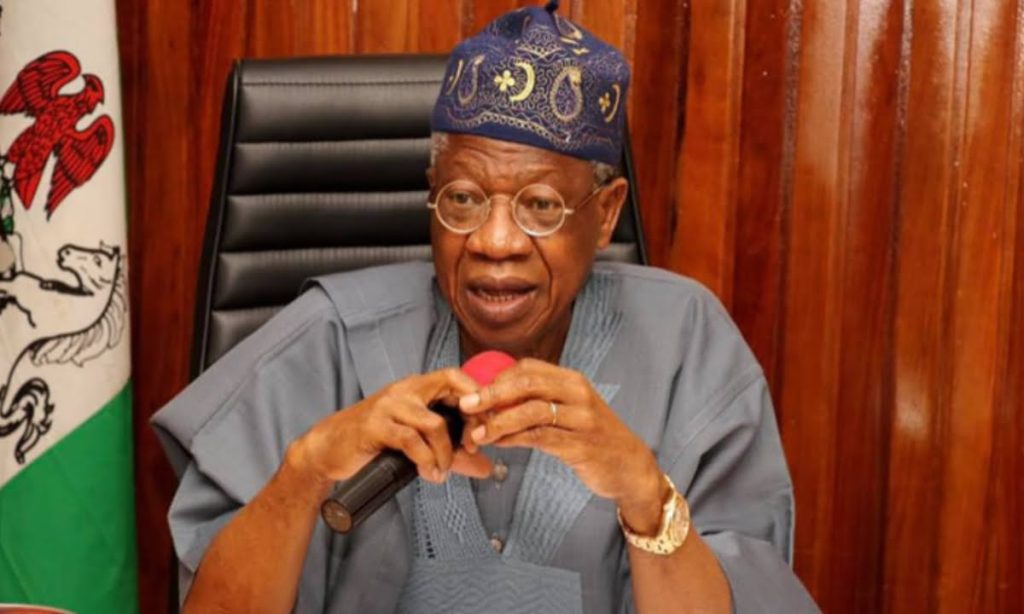
Nigeria’s former Minister of Information and Culture, Alhaji Lai Mohammed, has recounted how disciplined and strategic communication transformed a fragmented opposition into a unified national movement that successfully challenged the ruling party in 2015.
Speaking at Abbey College, Cambridge, UK, on Wednesday, Mohammed traced the origins of this political shift to the aftermath of Nigeria’s 2003 general elections, which he described as a “political tsunami” for the opposition.
“In 2003, Nigeria experienced a political tsunami, marking the opposition’s most significant setback in the nation’s political history,” he stated. “When Nigeria returned to democratic governance in 1999, the distribution of states among the three main parties was relatively balanced. The ruling Peoples Democratic Party (PDP) held 21 states, the All Peoples Party (APP) had nine, and the Alliance for Democracy (AD), which I was part of, controlled six states.”
However, the 2003 elections dramatically altered this landscape. The PDP gained seven additional states, bringing its total to 28, while taking five states from the AD, leaving it with only Lagos. The APP, which had rebranded as the All Nigeria Peoples Party (ANPP), lost two states but maintained seven.
Mohammed explained that these results decimated the AD’s power, structure, and influence, forcing it to seek new alliances. These efforts led to the formation of the Action Congress of Democrats (ACD), which evolved into the Action Congress (AC), and eventually the Action Congress of Nigeria (ACN).
Despite controlling just one state at the time, Mohammed noted that the ACN leveraged communication as its primary tool to position itself as Nigeria’s most prominent opposition force.
“In those days, communication was our most potent weapon. Every word mattered. Every message had to cut through the noise, because if it didn’t, we simply didn’t exist in the public consciousness,” Alhaji Mohammed recalled.
Through consistent public engagement, strategic messaging, and unwavering advocacy, the opposition gradually rebuilt public confidence and expanded its political footprint. The ACN grew from one state to six, enabling it to form coalitions with other parties to establish the All Progressives Congress (APC) in 2013.
Mohammed observed that the APC quickly became the dominant opposition force and ultimately defeated the ruling PDP in the 2015 general elections, marking a historic moment when a ruling party was voted out at the national level in Nigeria.
“That experience taught me that communication is not just about speaking—it’s about persistence, clarity, and strategic positioning,” the former minister reflected.
Looking back on his time in government, Mohammed indicated that his opposition experiences profoundly influenced his approach to governance when his party assumed power in 2015 and he was appointed Minister of Information and Culture.
“It reinforced my belief that communication is not an accessory to politics or governance,” he stated. “It is a fundamental tool for both.”




Comments are closed for this story.