
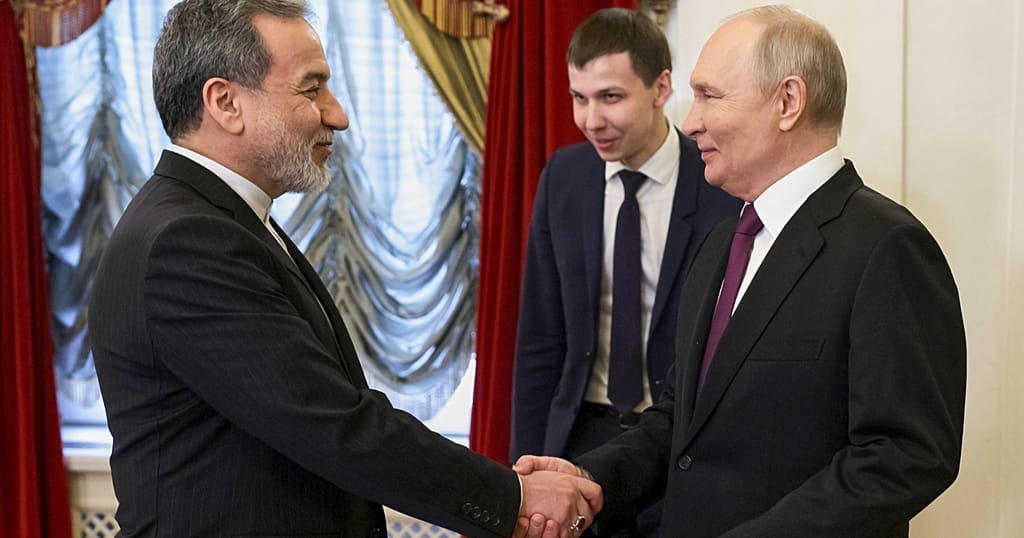
Russian President Vladimir Putin told Iran’s foreign minister that Moscow will do everything possible to help secure peace in the Middle East during a meeting in St. Petersburg on Monday. The comments, reported by Russian state media, came as Iran’s Foreign Minister Abbas Araghchi arrived in Russia to discuss the ongoing conflict in the region.
In the meeting, Putin praised the “courageous and heroic” resistance of the Iranian people, according to the TASS news agency. He added that Russia, like Iran, intends to maintain its strategic partnership and continue cooperation on regional matters.
Araghchi criticized the United States for what he described as a failure to achieve its objectives in the war involving Iran, and suggested that Washington’s call for negotiations reflects its limited success. “We are now considering it,” he told a Russian state‑run television reporter.
The talks took place against the backdrop of a fragile ceasefire that remains in effect despite sporadic fighting. Both Moscow and Tehran have previously emphasized their support for each other’s positions on the conflict, describing the relationship as a long‑standing strategic partnership.
While details of any specific diplomatic initiatives were not disclosed, the meeting underscored Russia’s willingness to play an active role in peace efforts. The Kremlin’s statement aligns with its broader foreign‑policy goal of positioning itself as a mediator in Middle‑East disputes, a stance that has grown in prominence as Western influence in the region faces challenges.
The encounter also signals Tehran’s openness to exploring diplomatic options, even as it continues to confront U.S. pressure. Araghchi’s remarks about the United States’ unmet goals and the potential for negotiations may hint at a shift toward a more active diplomatic engagement, although concrete steps have yet to be outlined.
The dialogue between Putin and Araghchi reflects the continuing importance of Russia‑Iran relations in shaping the dynamics of the Middle‑East conflict. As the ceasefire holds, both governments appear prepared to coordinate further diplomatic initiatives aimed at stabilising the region and advancing their mutual strategic interests.



Comments are closed for this story.