
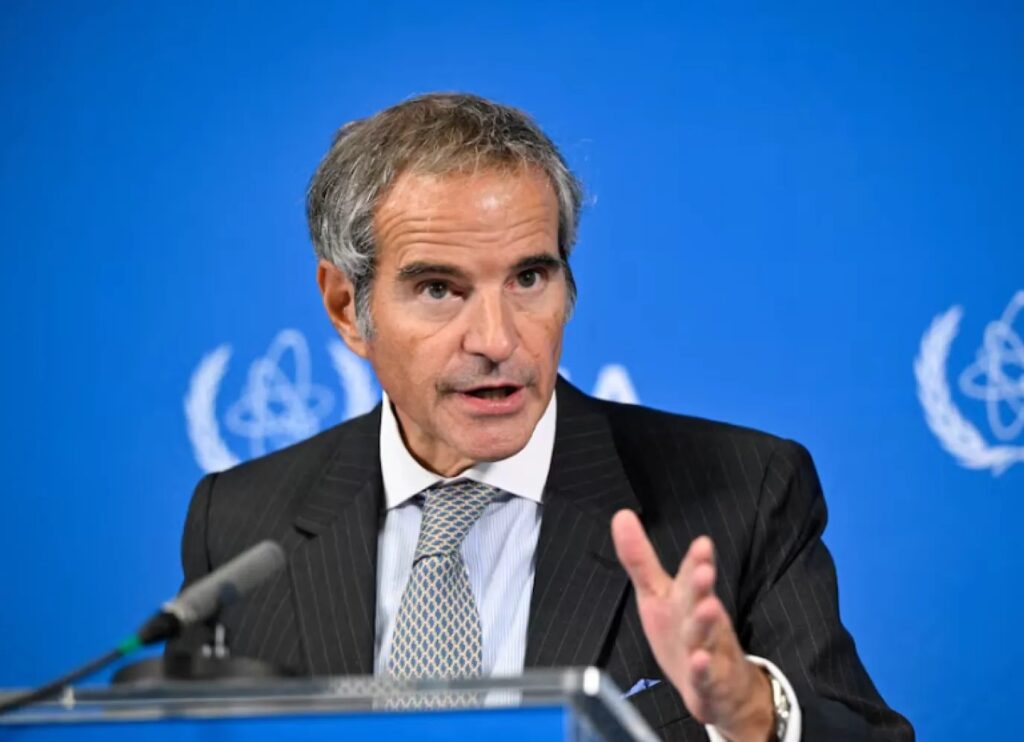
The International Atomic Energy Agency’s Director General Rafael Grossi told a press briefing at the United Nations on Wednesday that the 2015 Joint Comprehensive Plan of Action (JCPOA) cannot serve as the foundation for a new nuclear deal with Iran. Speaking on the sidelines of the latest review conference of the Nuclear Non‑Proliferation Treaty (NPT), Grossi said the JCPOA “could not constitute a basis” for any future agreement because Iran’s nuclear programme has changed significantly. “We need to look into something different,” he added.
Grossi was also questioned about reports that enriched uranium was buried under rubble following recent U.S.‑Israeli airstrikes in Iran. He confirmed that IAEA inspectors were still monitoring highly enriched material and had sealed approximately 440 kg of uranium during their last visit, which is scheduled to continue until June 2025. However, he noted that the agency could not verify the current status of the material until inspectors are allowed back on site.
Addressing the NPT review, Grossi called for renewed commitment to non‑proliferation, warning that a world with more nuclear‑armed states would be less safe. His remarks were echoed by Robert Floyd, Executive Secretary of the Comprehensive Nuclear‑Test‑Ban Treaty Organisation (CTBTO), who highlighted the continuing relevance of the test‑ban regime amid escalating geopolitical tensions.
Floyd explained that the Comprehensive Nuclear‑Test‑Ban Treaty (CTBT), which bans all nuclear explosions regardless of altitude or setting, has effectively curtailed nuclear testing. Since its opening for signature 30 years ago, fewer than a dozen tests have been conducted. The treaty enjoys broad support, with 187 signatories and 178 ratifications, but it has not entered into force because nine key states—China, Egypt, India, Iran, Israel, North Korea, Pakistan, Russia and the United States—have yet to ratify.
When asked about progress toward ratification, Floyd said that a coordinated move by the United States, Russia and China would be essential, noting that “it is quite unlikely that any one of them would move on that without the others simultaneously moving together.” He encouraged these nuclear‑technology states to consider joint action, describing such a step as “powerful” for the global non‑proliferation architecture.
The CTBTO’s verification network is now over 90 percent complete, operating 307 monitoring stations worldwide. The system successfully detected all six of North Korea’s nuclear tests, including its smallest device. Current capabilities allow detection of explosions equivalent to 500 tonnes of TNT—about 2‑3 percent of the Hiroshima bomb—providing a robust deterrent against clandestine testing.
Floyd also addressed misinformation surrounding seismic events in late 2024 that were mistakenly linked to Iranian nuclear tests. He clarified that analyses by CTBTO experts identified the signals as natural earthquakes in northern Iran, underscoring the organization’s role in countering disinformation.
Both officials stressed that, despite significant advances in arms control over the past three decades, further efforts are needed to strengthen international peace and security. The next steps include reopening IAEA inspection access in Iran and securing the ratification of the CTBT by the remaining key states.




Comments are closed for this story.