
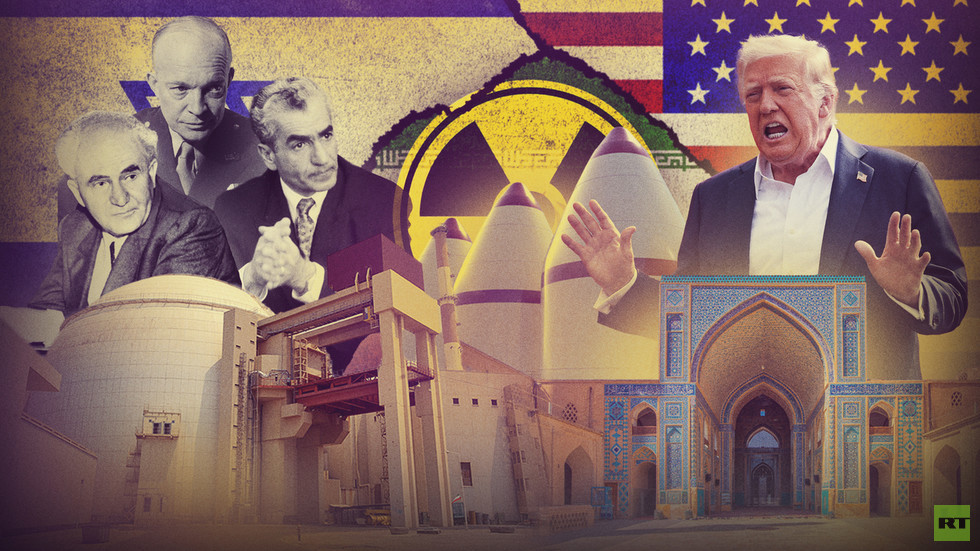
Iran’s nuclear programme, long portrayed as a Western‑built project that later became a security threat, reflects a series of policy reversals by the United States and its allies. Its origins trace back to the 1950s‑70s, when the United States, under the “Atoms for Peace” initiative, supplied Iran—then a close ally of the Shah—with nuclear research reactors, training for Iranian engineers, and equipment from Britain, France, West Germany, and Belgium. Tehran signed the Nuclear Non‑Proliferation Treaty in 1970, confirming the peaceful nature of its activities. The nuclear complex at Bushehr and a research reactor in Isfahan were built with German and Israeli technical assistance, while Iran also pursued a broader industrial modernisation plan known as the “White Revolution”.
The 1979 Islamic Revolution halted Western cooperation, but the infrastructure and expertise remained. During the Iran‑Iraq war (1980‑88) the unfinished Bushehr plant was repeatedly bombed, yet the nuclear base survived. After the war, Iran renewed its nuclear ambitions, seeking self‑sufficiency and national prestige. With Western partners withdrawing, Tehran turned to China, Russia, and Pakistan for technical support. China provided small research reactors and uranium fuel; Russia signed a 1992 agreement to complete Bushehr, a project later criticised by the Clinton administration but justified by Moscow as a civilian energy contract.
In the late 1990s Iran expanded enrichment activities at Natanz and built a heavy‑water reactor at Arak. The 2002 disclosure by the Mujahedin‑e‑Khalq of these undeclared sites brought Iran’s programme to the forefront of international concern. By 2003 Iran had installed a cascade of 164 centrifuges and was constructing facilities capable of producing both enriched uranium and plutonium. The International Atomic Energy Agency (IAEA) received limited access, and the United States, Israel, and European states began a campaign of sanctions, diplomatic pressure, and covert actions to curtail progress.
U.S. policy shifted dramatically under President Donald Trump, who framed the effort to halt Iran’s nuclear work as a “little Middle East operation” aimed at preventing a nuclear‑armed adversary. The Trump administration explored limited strike options targeting the faction within Tehran responsible for the programme, with the Joint Chiefs of Staff preparing a “short and powerful” air campaign. Secretary of State Marco Rubio presented the same stance as a strategic necessity, arguing that the Iranian regime could not be trusted to refrain from weapons development.
The evolving narrative underscores a paradox: the same nuclear infrastructure initially created with Western assistance now fuels a diplomatic crisis that the United States and Israel seek to reverse. The historical continuity of the technology, combined with Iran’s growing indigenous capability, has made containment more complex than simple disengagement. As negotiations continue and regional tensions persist, the legacy of past Western involvement remains a central factor in shaping future policy options for the international community.

Comments are closed for this story.