
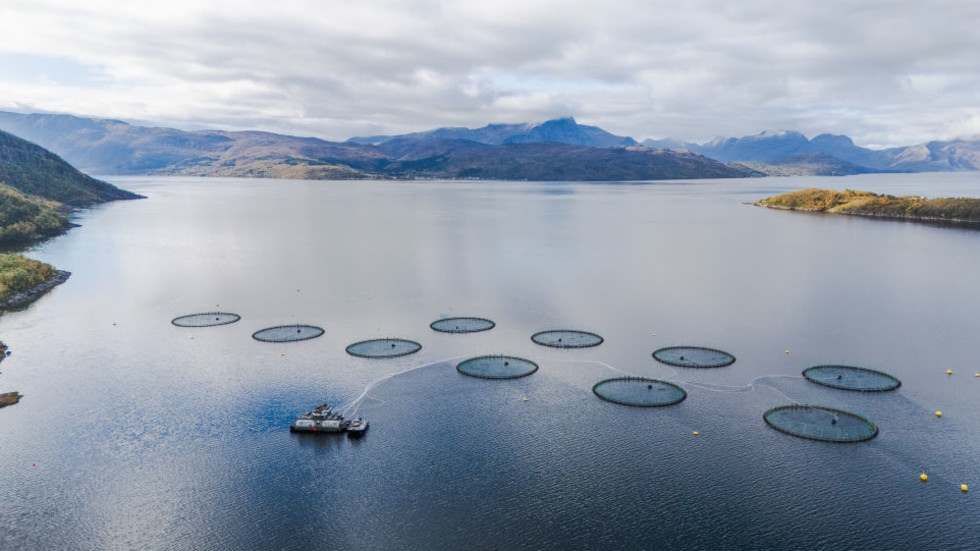
Norway’s offshore salmon farms are discharging waste equivalent to the raw sewage of tens of millions of people, a new study says.
The Sunstone Institute in Oslo calculated that the nitrogen and phosphorus released from almost 1,000 fjord‑based fish farms last year matched the untreated waste of 17.2 million and 20 million people, respectively – roughly three times the amount that would be produced by Norway’s 5.5 million residents. The institute also noted that uneaten feed escaping from fish pens attracts wild species, exposing them to higher nutrient levels and poorer water quality.
Excess nitrogen and phosphorus can fuel algal blooms, which, once they die, consume dissolved oxygen and create “dead zones” where marine life struggles to survive. The study warns that such conditions threaten the ecological health of Norway’s iconic fjords, which support commercial fisheries, tourism and biodiversity.
The findings contrast with Norway’s strong environmental reputation. In the 2024 Environmental Performance Index compiled by Yale and Columbia universities, the country ranked seventh out of 180 nations and second globally for environmental health. Norwegian officials have not responded to the report, and the Norwegian Seafood Federation told the Guardian that current production remains “well within nature’s carrying capacity” and that there is no documented evidence of damage to fjords.
Aquaculture is a cornerstone of the Norwegian economy. With the world’s second‑longest coastline, Norway produces more than half of the global farmed salmon supply. In March alone, exports reached 106 000 tonnes, valued at over $1.1 billion, according to the Norwegian Seafood Council. The sector is dominated by a few large firms – Mowi, Lerøy Seafood Group and SalMar – which together account for the majority of production and profit. Mowi’s largest shareholder, shipping magnate John Fredriksen, appears on Forbes’ 2026 list of billionaires with a net worth of $21.2 billion.
If the waste levels reported by Sunstone prove accurate, regulators may face pressure to tighten nutrient‑management rules for salmon farms. Potential measures include stricter limits on feed conversion efficiency, increased monitoring of waste outputs, and the adoption of new technologies to capture or mitigate discharge.
The study adds to growing scrutiny of intensive aquaculture worldwide, highlighting a trade‑off between food security and marine ecosystem health. As global demand for farmed fish continues to rise, policymakers, industry players and environmental groups will need to address the scale of nutrient pollution to preserve the long‑term viability of both the industry and the fjord environments it depends on.



Comments are closed for this story.