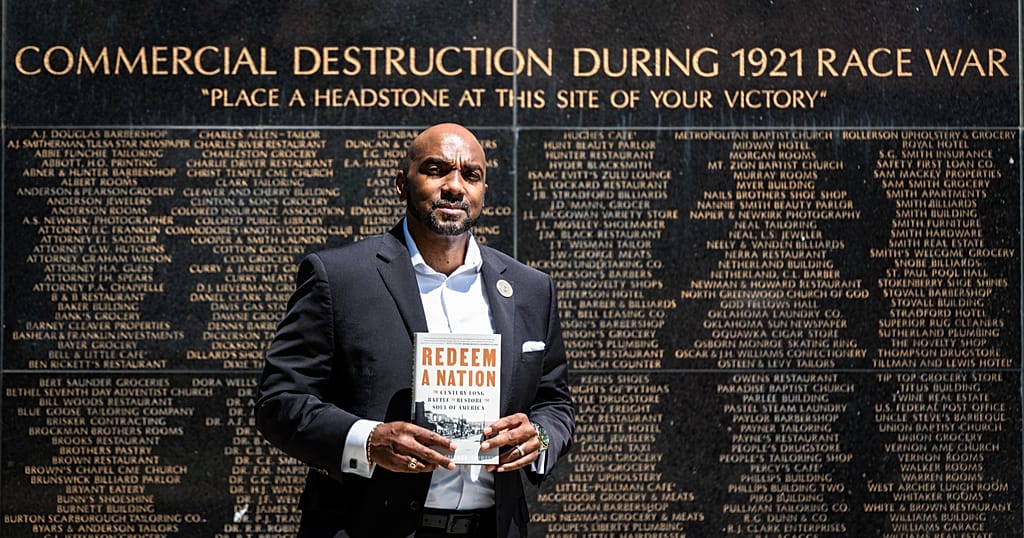
Tulsa’s Century‑Old Quest for Reparations Finds New Momentum
A century after the 1921 Tulsa Race Massacre razed the prosperous Black district of Greenwood—once dubbed “Black Wall Street”—the United States remains locked in a contentious debate over reparations. Civil‑rights attorney Damario Solomon‑Simmons is now at the forefront of a renewed push to obtain compensation and community investment for survivors and their descendants. His efforts are the centerpiece of his forthcoming book, Redeem a Nation: The Century‑Long Battle to Restore the Soul of America, which examines how the legacy of slavery, racial violence and systemic discrimination continues to shape American society.
On May 10, 2021, the 100th anniversary of the massacre spurred a wave of public remembrance, prompting state and local officials to issue formal apologies and to create a $10 million trust fund for educational and cultural projects in Tulsa. While the initiative was welcomed as a symbolic step, activists and scholars argue that monetary gestures fall short of addressing the deep‑seated economic and social wounds inflicted on the Black community that night.
Solomon‑Simmons, a Tulsa‑based attorney who represents several descendants of the massacre’s victims, says the current reparations dialogue must move beyond symbolic gestures toward tangible, long‑term investments. “We are not just asking for cash,” he told reporters in a recent interview. “We are demanding a comprehensive plan that rebuilds our neighborhoods—through quality schools, affordable housing, accessible health care and pathways to economic empowerment.”
The attorney’s position reflects a broader scholarly consensus that reparations should be community‑focused. Historians note that Greenwood’s destruction erased more than property; it eliminated generations of wealth, education and entrepreneurial capital that could have propelled Black economic advancement for decades. Economists estimate that, adjusted for inflation, the material damage exceeded $2 billion. Yet, unlike the direct theft of property in other historical contexts, the massacre’s aftereffects are diffused across multiple generations, complicating legal claims.
Opponents of reparations argue that no living perpetrators or enslaved victims remain to file direct lawsuits, contending that any compensation would be anachronistic. Critics also warn that large‑scale payouts could set precedents for other historical grievances, potentially destabilising fiscal policy. In response, Solomon‑Simmons points to the federal government’s recent acknowledgment of slavery’s lasting impact through the 2021 “Commission on Racial Equity” report, which recommended targeted investments rather than blanket monetary awards.
Public sentiment appears to be shifting. A recent poll conducted across several U.S. states showed that 57 percent of respondents now favor reparations in the form of community development programs, up from 42 percent five years earlier. Social media commentary following the anniversary highlighted personal stories from Greenwood descendants who still face housing insecurity and limited access to quality education—a direct link to the massacre’s lingering impact.
Legislatively, the conversation is gaining traction. In February 2024, the Oklahoma Senate introduced Bill 527, proposing a $30 million appropriations package to fund scholarship programs, mental‑health services and small‑business grants for the Tulsa region. The bill, however, faces opposition from fiscal conservatives who question its funding sources and long‑term efficacy.
As the debate unfolds, the case of Tulsa serves as a litmus test for how the United States might address historical racial injustices on a national scale. Solomon‑Simmons’s upcoming book promises to chart the century‑long struggle, offering both a historical record and a blueprint for future policy. Whether lawmakers will translate the growing public support into concrete action remains to be seen, but the renewed focus on Greenwood suggests that the call for reparations is no longer a footnote of history—it is an active agenda shaping America’s contemporary discourse.
For African readers observing the United States’ reckoning with its past, the Tulsa initiative underscores a broader global conversation about how nations confront historic wrongs and invest in restorative justice. The outcomes in Oklahoma could influence policy debates across the continent, where post‑colonial societies grapple with similar demands for redress and development.