
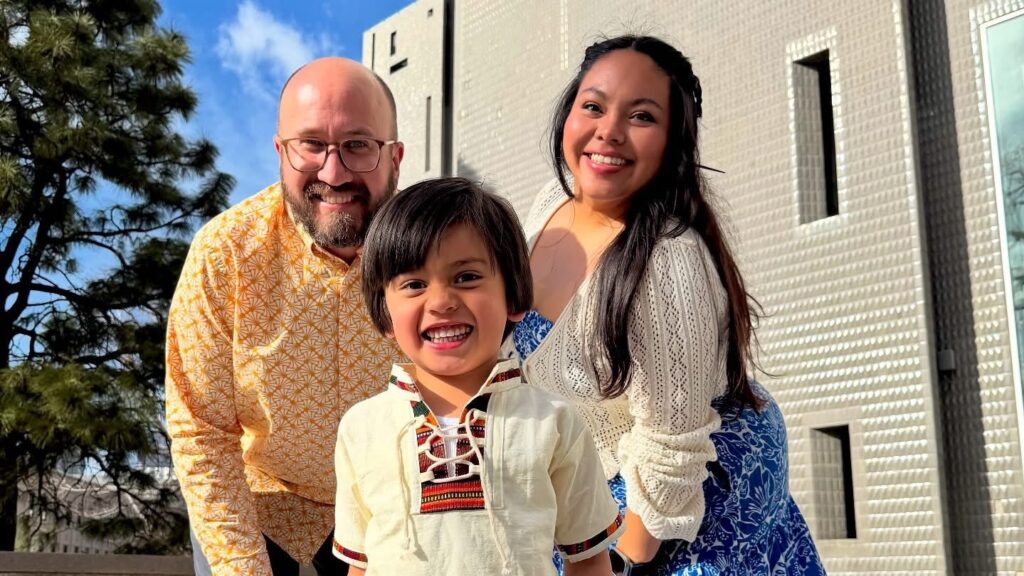
Ana Temu Otting calls her five-year-old son David as American as apple pie. Born to a Guatemalan-Mexican mother and a Swedish-German father, he embodies the melting pot that defines the nation. But a looming Supreme Court decision could strip automatic citizenship from hundreds of thousands of babies born each year to parents who entered or stayed in the U.S. without authorization, or are here temporarily.
Migrant-rights advocates fear the court might go further, potentially allowing the president or Congress to revoke citizenship from tens of millions of adults born in the U.S. to undocumented parents. Such a ruling could render millions deportable to countries they’ve never known. Among them is Temu Otting herself, born in Los Angeles to parents without legal status at the time. The threat has sparked tense conversations across an estimated 4.7 million mixed-status families, many of whom have always believed they are Americans.
Though both Temu Otting and her husband were U.S. citizens when David was born, she worries the Supreme Court is dangerously willing to let President Donald Trump undo generations of citizenship. “It feels like all bets are off the table for anyone at this point, and what’s happened so far is so unprecedented,” said Temu Otting, who runs a union print shop in suburban Denver. “We do talk about it daily. But if we do talk about it too much, it will put us into a depressive mood.”
Noah Baron, assistant litigation director for Asian Americans Advancing Justice, said Trump’s push to end birthright citizenship—a direct challenge to the mainstream interpretation of the 14th Amendment and federal immigration law—has thrown a once-settled question into chaos. “These rights that we once considered fundamental, the ground has shifted under our feet and has left many, many people concerned,” Baron said. His group is suing the administration over the executive order.
The 14th Amendment grants citizenship to virtually everyone born on U.S. soil. But the Supreme Court is close to a decision that could open the door to Trump’s goal of withdrawing citizenship from millions. Congress passed the amendment in 1866 after the Civil War to ensure formerly enslaved people and their children were citizens. In 1898, the Court ruled 6-2 that a man born in San Francisco to Chinese parents was an American citizen, citing the amendment’s phrase “subject to the jurisdiction thereof.” That language has since been used to deny citizenship to children of foreign diplomats and soldiers stationed in the U.S.
In January 2025, Trump issued an executive order titled “Protecting the meaning and value of American citizenship,” ending birthright citizenship for newborns. The Supreme Court now decides whether to let it take effect. If approved narrowly, the order would affect about 255,000 babies annually, leaving them effectively stateless. Trump has not outlined a plan for what follows, but has made the change a top priority. In April, he became the first sitting president to attend Supreme Court arguments, watching from the gallery.
“We are the only Country in the World STUPID enough to allow ‘Birthright’ Citizenship!” Trump posted on social media. Globally, 32 countries have similar laws, with about 50 offering more limited versions, according to Pew Research. The White House did not respond to requests for comment on how revocations might work. Supporters argue only those who enter through proper legal channels should have children who become citizens.
In a legal brief backing Trump, several Republican members of Congress, led by Texas Sen. Ted Cruz, claimed abuse of the system. They estimated 50,000 Chinese people travel to the U.S. annually for “birth tourism,” a practice never envisioned by those who wrote citizenship laws. “The national security implications of misconstruing the Citizenship Clause are thus real, immediate, and severe. If the Court adopts Plaintiffs’ reasoning, then it will strip from Congress much of its power to prevent hostile nations from manufacturing nominal citizens,” they wrote.
Of the roughly 14 million undocumented people in the U.S., nearly 80% came from Mexico and Central and South America, according to the Aoki Center at UC Davis. Another 5.5 million to 6.5 million have temporary or provisional status, including asylum seekers, DACA recipients, and humanitarian program entrants. More than 90% came from Latin America, Asia, Africa, and the Caribbean.
Temu Otting said she’s fairly confident neither she nor her son would be deported, but remains worried because that could become a possibility if Trump wins at the Supreme Court. Her mother and aunt made the risky journey to the U.S., drawn by promises of freedom, safety, and success. Both eventually became citizens, though her father was deported to Mexico. “It’s just feels really unfortunate that so many promises of this country are being rolled back or threatened,” she said. “It just really violates the promise of this country of being a place where anyone can prosper, a place where people can come to be free, to get an education.”

Comments are closed for this story.