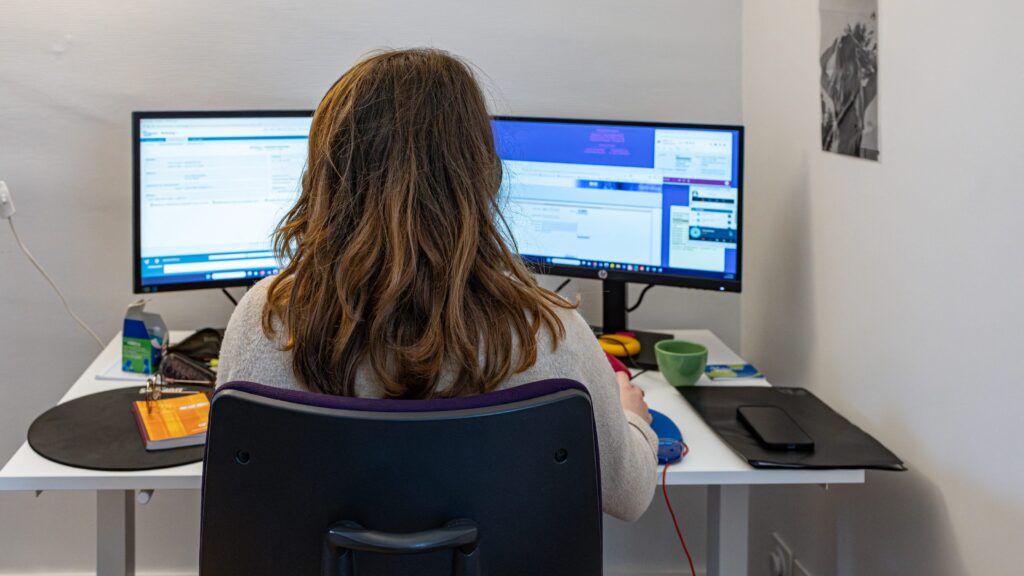
Alyse Lopez-Salm lives in a small North Carolina town, near the military base where her husband works. She’s one of 35 million Americans who now work from home. Pregnant with her second child, she starts her day with a morning exercise class that replaced her old hour-long commute. When her 6-year-old finishes summer camp, she picks him up during lunch. And when her rheumatoid arthritis flares, she works from the carpeted floor of her home office.
“Working from home is everything to me,” Lopez-Salm said. “Your results are what matter, not you physically being in a building.”
The pandemic reshaped how America works, and many say it’s been a blessing. No more rush-hour traffic. Parents can attend doctor appointments and soccer games. The sandwich generation cares for aging parents without missing work. People with disabilities find more job opportunities. Remote workers might even have more children.
But there’s a darker side. About half of remote workers feel less connected to colleagues. Younger workers lose mentors. Work bleeds into home life. And now, a study from researchers at the Federal Reserve Bank of New York, the University of Virginia, and Harvard University, published in Science, raises a new alarm: remote work may be worsening mental health.
Emma Harrington, one of the study’s authors, says more Americans are lonely, and the way they work fuels that isolation. The study, based on data from over 588,000 workers, found that nearly 9 in 10 remote-capable workers spend their workdays completely alone. They socialize less after work, sometimes going days without face-to-face interaction. Researchers linked this to higher rates of distress, mental health visits, and antidepressant use. Between 2011 and 2024, remote work accounted for a third of the increase in mental distress, especially among those living alone.
“Everyone sees an increase in the number of hours they’re spending alone, largely driven by their workday,” said Harrington, an economics professor at the University of Virginia and coauthor of the upcoming book “In Person.” “But for people living alone, that’s more likely to translate into just spending your entire day with no social contact and never leaving the house.”
The findings sparked heated debate. Some academics point to research showing remote and hybrid work boost well-being. In two randomized trials by Stanford economist Nick Bloom, workers reported improved mental health, not worse.
“The simple story is when people can work from home, they can reduce commuting stress, control their time better and have more time with friends and family,” Bloom said.
Remote work affects people differently, Bloom added. Some crave company and prefer the office. Others want full remote. For many, hybrid work is the sweet spot. His solution? Let workers choose what works best for them.
“If anyone finds working from home problematic, they can always go into the office or change jobs,” he said. “So I don’t see how you can find something that employees love and repeatedly choose to do can be bad for them.”
Newton Cheng, who spent 17 years overseeing health and performance programs at Google, witnessed the isolation firsthand. When he left his corporate job last September to work independently, he missed the office chitchat and face time.
“I think the evidence clearly shows that hybrid and remote work really help people’s health and well-being. However, for me personally, I find remote work kind of isolating,” he said. “If you leave me to my own devices, I could sit in an office and just do research and reading and writing and not see anyone for days at a time. So I have to find other ways to socialize and spend time with people, or else I start to feel lonely.”
Cheng now schedules in-person meetings, works from coffee shops or libraries, and strikes up conversations. He takes his kids to a pizza truck at a nearby park every Tuesday to bond with other parents. He trains at a friend’s gym instead of his garage to connect with fellow power lifters.
“I don’t think the workplace should be at the top of my list for places where I go to make friends, but that is the reality for so many of us,” Cheng said. “Now, many of us see each other face-to-face much less the way we have in the past.”
Gemma Dale, a researcher and remote work specialist, says the mental health crisis is global. Long before the pandemic, Americans began spending more time alone. Work bonds once helped replace declining community activities like church or sports teams. Recent workplace shifts have deepened the loneliness epidemic.
“Even within this report, the worst symptoms are experienced by those who live alone, which highlights what we’ve known for decades – the remote work experience is contextual,” Dale said.
Ruth White, a psychotherapist and workplace mental health consultant, worked remotely for nearly a decade and loved it. She traveled, sailed on Wednesdays, and walked a lake daily. But in her practice, she saw workers relying on the office for all their social needs.
“When work becomes primarily virtual, those opportunities for connection can disappear and many people feel isolated and may experience depression or anxiety,” she wrote on LinkedIn.
White helps clients build social lives outside work. “The healthiest workplaces of the future won’t be those that force everyone back to the office or those that abandon in-person connection altogether,” she said. “They’ll be the ones that intentionally create opportunities for meaningful human connection – whether employees work remotely, hybrid, or in person.”
Brian Elliott, CEO of Work Forward and publisher of the Flex Index, agrees. “Asking the office to fix the loneliness epidemic is a tall order,” he told USA TODAY. But employers can do more. “The issue is that most companies treat remote work as a default, not as something that requires design around connection. Firms cut back on gatherings, travel budgets, training. No one’s checking in. No one’s engineering moments that matter.”
He argues the study’s findings don’t mean everyone should return to the office. Simple fixes can help. A recent study found that remote workers coming to the office one day a month boosts productivity by 8%, cuts attrition by a third, and improves job satisfaction and communication.
Harrington isn’t suggesting a return to 2019. Instead, employers and employees should create “purposeful doses of in-person time” like weekly one-on-ones or regular off-sites.
“The pre-pandemic office was not always a super social place and people often were just working in their own cubicles,” she said. “There is an opportunity to do more with fewer days if we’re just more intentional about how those days are actually being spent.”