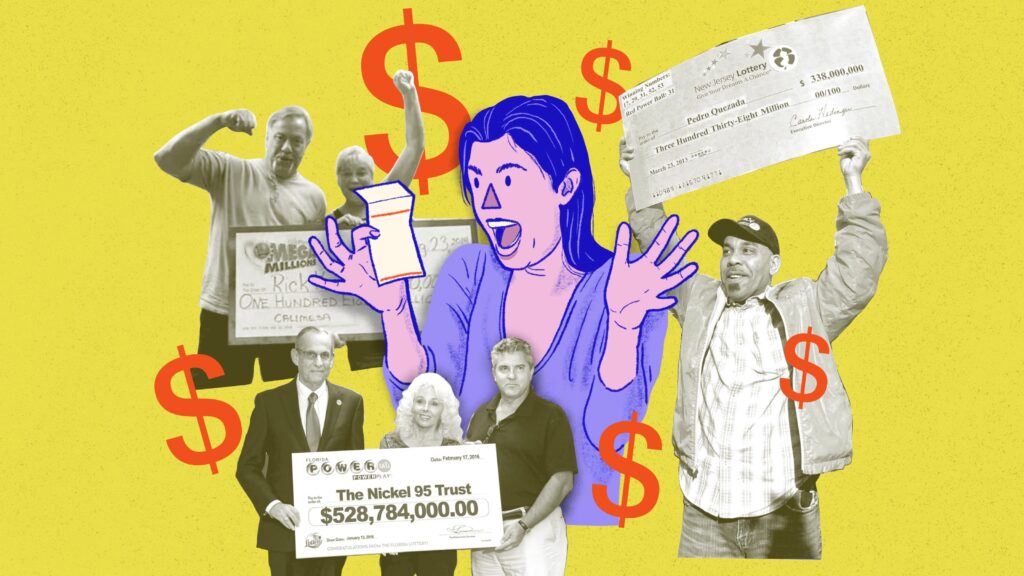
Everyone who has ever bought a lottery ticket has daydreamed about the win. The sprawling family compound, the vacation home, the early retirement, the vintage cars. But lurking behind those fantasies is the dark whisper of the lottery curse: the winner who loses it all, ends up in prison, or dies tragically.
A common but untraceable statistic claims that one-third, or even 70 percent, of winners go broke within a few years. USA TODAY decided to put that myth to the test. We tracked 31 publicly identified Powerball winners who claimed jackpots over $50 million between late 2012 and 2016. All have now lived at least a decade as millionaires.
We combed through news archives, public records, and social media. We called, texted, and emailed. It was hard work; lottery winners tend to vanish. But we found a surprising truth: the curse is mostly a myth.
Of the 31 winners, at least nine have clearly thrived. They have lived good lives, celebrated their fortune, and given back to their communities. Seven started charitable foundations. Only two have seemingly succumbed to the curse, generating the kind of national headlines that fuel the legend.
Pedro Quezada of New Jersey faced a storm of bad press after his 2013 win, culminating in a 2017 arrest on sexual assault charges. His lawyer claimed the accuser fabricated the story to get at his money. The charges were later dropped. Marie Holmes of North Carolina spent millions on a fiancé who was prison-bound, eventually appearing on the Oprah Winfrey Network show “Iyanla, Fix My Life” to recount her unraveling life.
What about the other 20? We don’t know much. At least two are dead. The rest live quietly out of the public eye. William ten Broeke has quietly supported medical research through an Atlanta foundation. Another family lives on a $6 million, 10-bedroom estate on 320 acres in rural Tennessee with a private lake. None have made national headlines for a decade or more. They seem to be doing just fine.
So, what is the lottery curse? It endures as a morality tale, woven from a few tragic narratives. The real curse, winners say, is not penury or death. It is a few weeks in celebrity hell. Your phone rings off the hook. Your inbox fills with pleas from strangers and long-lost relatives. Your doorbell rings at odd hours.
“When you have money, it doesn’t solve all of your problems,” said Thomas Murphy, a certified financial planner in Dallas who has worked with lottery winners. “It solves some of your problems. And it introduces a whole host of new problems.”
Susan Brands of St. Charles, Missouri, won a $96.5 million Powerball jackpot in 2014. In the days that followed, she said, “we had all kinds of letters from people who said God told them we were going to give them money.” The Brands started a foundation to give back. Their biggest extravagance? Hiring a private jet to see an Eagles concert in Las Vegas. She still uses coupons at the grocery store.
Roy Cockrum, a former Episcopal monk and struggling actor, won $260 million in 2014. He took half his after-tax prize, roughly $60 million, and opened a foundation to fund ambitious theater projects. To date, it has awarded 56 grants totaling more than $34 million. Two of the plays he supported have earned Tony Award honors.
The Smiths of Trenton, New Jersey, have given away more than $17 million through their family foundation, focusing on training nonprofit leaders and helping local students finish college. “There comes a point where it’s like, what else can you buy?” said Katherine Nunnally, one of seven Smith children and the foundation’s executive director. “You have to do something that’s meaningful.”
The Hills of Dearborn, Missouri, won $294 million in 2012. They stayed in their small town, launched a foundation, and funded a new fire station. “I didn’t do anything to earn this,” Mark Hill told a local newspaper. “It’s not like I found a cure for cancer or anything.” He died in 2019 at age 59.
The lottery curse is real, but it is not what you think. It is a short, intense storm of unwanted attention and bad advice. And then, for most, it lifts. They are free to live their dreams. “I’ve been there with people who have gotten the check, and seen the look on their faces,” said Stephen Durrell, executive director of the Kansas Lottery. “And it’s a tremendous feeling.”