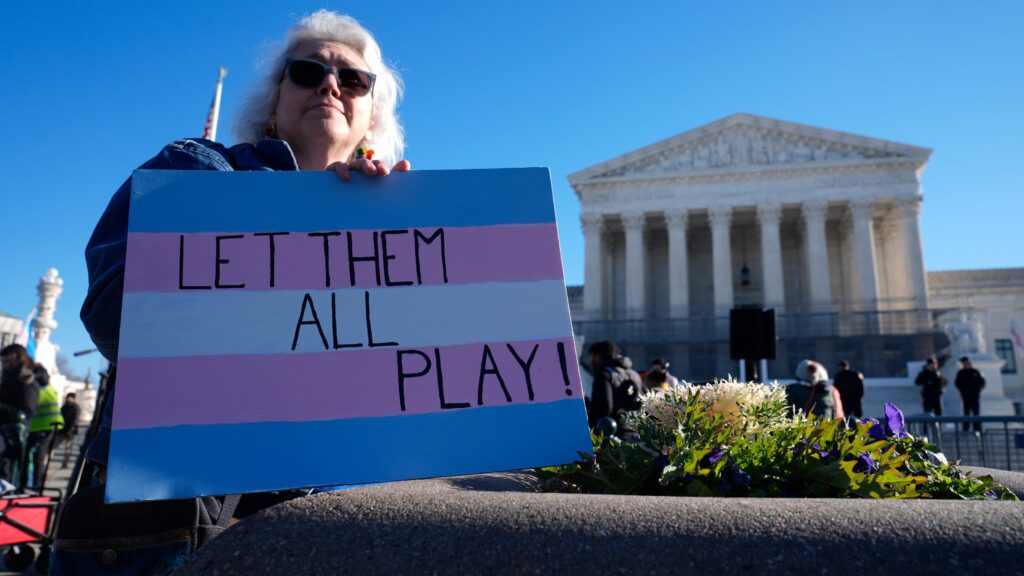
The Supreme Court delivered a decisive blow to transgender rights on June 30, ruling that states can legally bar transgender women and girls from competing on female sports teams. The decision, one of the term’s most anticipated, marks another conservative shift from the high court, which has increasingly ruled against transgender Americans in recent years.
In a 6-3 decision, the justices upheld West Virginia and Idaho laws that prohibit transgender athletes from participating in girls’ and women’s sports, citing that these bans do not violate the Constitution or federal sex discrimination laws. Twenty-seven states have enacted similar measures, arguing they preserve fairness and safety for non-transgender women.
The laws define eligibility based on “biological sex” at birth, ignoring an athlete’s medical transition or athletic ability. Transgender students who challenged the bans argued that hormone therapy and other treatments eliminated any physiological advantages from being born male. They hoped to rely on a 2020 Supreme Court precedent protecting transgender employees from workplace discrimination, but the court has since taken a harder line, including a 2025 ruling allowing states to ban gender-affirming care for minors.
President Donald Trump’s administration supported the bans, with the Justice Department defending them before the court. Trump made opposition to transgender athletes a pillar of his 2024 campaign and has threatened to cut federal funding to schools that allow transgender females to compete.
The case drew intense public scrutiny. Lindsay Hecox, a Boise State student, tried to withdraw her challenge to Idaho’s law after the case was argued, fearing the spotlight. She argued that her suppressed testosterone and estrogen therapy put her on par with non-transgender women, but the justices ultimately ruled solely on the West Virginia case.
Becky Pepper-Jackson, who challenged West Virginia’s law as a middle schooler, takes puberty-delaying medication and estrogen. She placed third in a state discus competition and eighth in shot put last year, but her lawyers argued her performance was within the range of non-transgender girls. West Virginia countered that she retained a physical advantage, while the state’s attorney said legislatures, not courts, should decide such issues.
Justice Brett Kavanaugh, a father of daughters who play basketball, acknowledged the emotional stakes. “I hate the idea that a kid who wants to play sports may not be able to,” he said during arguments, but noted that allowing a transgender girl on a team could displace another athlete.
The scope of the issue remains unclear. NCAA President Charlie Baker told a Senate panel in 2024 that fewer than 10 transgender athletes compete in college sports. The Williams Institute at UCLA estimates up to 122,000 transgender youth could be in high school athletics, with less than 1.5% of college athletes likely being transgender.
Polls show broad public support for requiring athletes to compete based on sex assigned at birth, but advocates argue the controversy is overstated. Pepper-Jackson was the only transgender student in West Virginia seeking to play on girls’ teams. Her attorney, Joshua Block of the ACLU, urged the court to avoid a sweeping ruling, saying, “Maybe a trial could make the issue go away.”