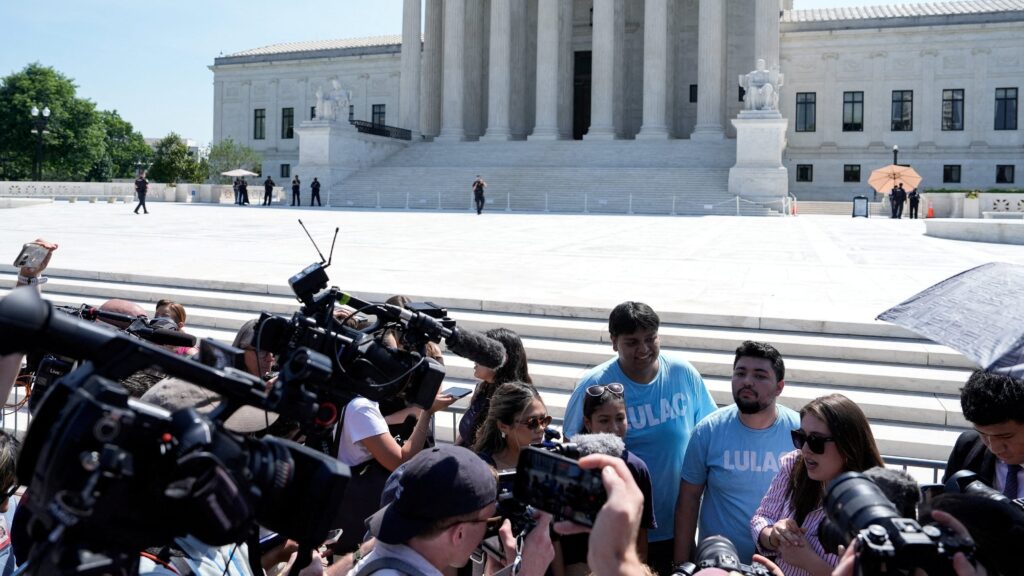
In a defining moment for the nation’s constitutional fabric, the Supreme Court ruled that all children born on U.S. soil are citizens, reaffirming a 125-year-old principle and dealing President Donald Trump a stinging defeat on one of his signature agenda items. The decision, handed down on a day packed with major rulings, struck down Trump’s executive order from the first day of his second term, which sought to limit citizenship to children of citizens or legal permanent residents, excluding those born to tourists or undocumented immigrants.
The high court grounded its ruling in the 14th Amendment, ratified in 1868 and solidified by an 1898 precedent, interpreting it as guaranteeing citizenship to every baby born in the country, regardless of parental status. Trump, reacting on social media, called the outcome “too bad” but urged Congress to pursue legislation to enact his proposed restrictions on temporary or unlawful visitors having children. Justice Brett Kavanaugh, while part of the 6-3 majority overturning the executive order, noted that the Constitution would not block Congress from passing such a law, though he did not join the 5-4 majority affirming the 14th Amendment’s full scope.
The court also ruled 6-3 to allow states like West Virginia and Idaho to ban transgender athletes from female sports teams, a win for Trump, who has vocally opposed transgender participation. In another 6-3 decision, the conservative majority sided with Vice President JD Vance and Republicans, striking down a decades-old law limiting how much political parties can spend in coordination with election candidates, a move Trump hailed as a victory for free speech and his party.
Dissenting voices were sharp. Justice Clarence Thomas, joined by Justice Neil Gorsuch, argued the majority had “repurposed” the 14th Amendment from its original intent of securing rights for freed slaves, extending it to “foreign birth tourists” and unauthorized immigrants. Justice Samuel Alito, in his own dissent, focused on the amendment’s “subject to the jurisdiction thereof” clause, arguing it should exclude those Trump targeted, and warned of “grotesque results” like automatic citizenship for children of birth tourists while lawful immigrants wait years.
The ruling drew praise from advocates and descendants of historical figures. Norman Wong, great-grandson of Wong Ark Kim—whose 1898 case established birthright citizenship—said his ancestor “stood up for what is right” and defended the rights of all Americans. Stop AAPI Hate welcomed the decision but expressed concern about future Trump administration actions, noting that attacks on birthright citizenship are part of a broader plan to “make America permanently hostile to people of color.”
For Ana Temu Otting, a Denver-area resident born to undocumented parents in Los Angeles, the ruling brought relief but lingering fear. “It is a relief, but there is still a big looming cloud of uncertainty because this administration and time of deep racism is still not over,” she said, worrying about her 5-year-old son’s future. On the other side, anti-immigration hardliners like former Border Patrol commander Greg Bovino urged Trump to restart mass detention and deportation operations.
The court’s decisions also ignited reactions on transgender rights. Joshua Block, an ACLU attorney representing transgender athletes, called the sports ban ruling “heartbreaking,” while West Virginia Attorney General JB McCuskey praised it as a “monumental victory” for female athletes. Idaho Attorney General Raul Labrador echoed that sentiment, saying it protects opportunities “generations of women fought to secure.”
Senator Dick Durbin of Illinois, who led a group of 216 congressional Democrats in supporting birthright citizenship, expressed relief, calling Trump’s order an attack on millions of Americans with immigrant heritage. “We are a nation of immigrants,” he said, “and we must end this anti-immigrant campaign fueled by fear and hatred.”
Chief Justice John Roberts authored the majority opinion striking down Trump’s order, joined by Trump appointee Amy Coney Barrett and the court’s three liberals. Kavanaugh wrote separately, agreeing the order was unlawful but arguing it violated a federal statute, not the Constitution, leaving room for Congress to act. The three full dissenters—Thomas, Alito, and Gorsuch—maintained the order was fully lawful.
The ruling capped a term marked by major cases on executive power, with Trump facing losses on tariffs, deportation protections, and firing independent agency leaders. As the justices scattered for summer, the decision cemented birthright citizenship as a bedrock principle, even as debates over its future simmered in Congress and beyond.