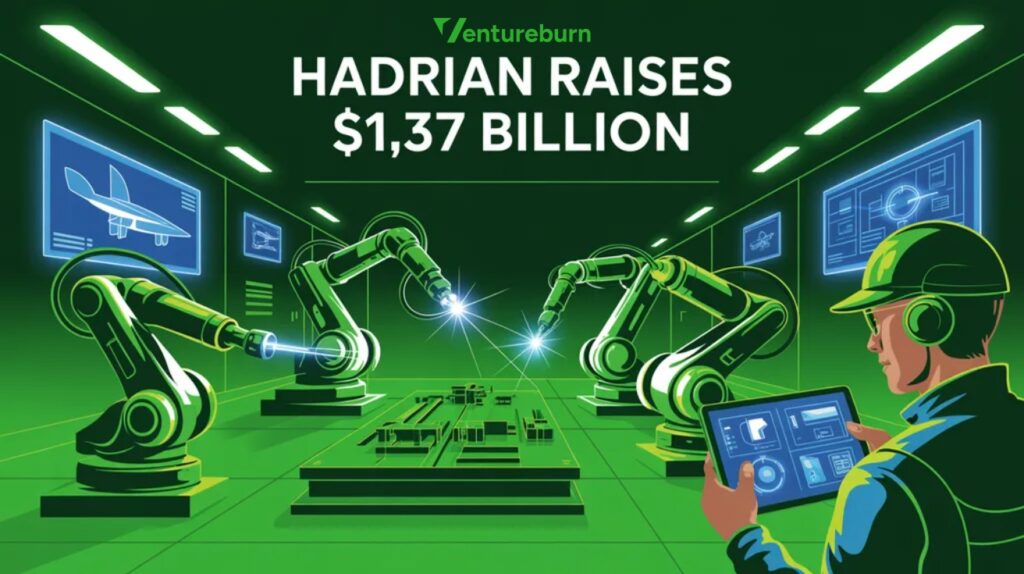
Hadrian has secured $1.37 billion in new financing to scale its automated, software-driven manufacturing platform, pushing the company’s valuation toward $8 billion. The funding round positions the startup as a central player in the effort to modernize defense industrial capacity in the United States.
The capital will fund rapid expansion of Hadrian’s physical footprint, including its high-throughput facility in Mesa, Arizona, which the company says can move from groundbreaking to full operation in under six months. The investment arrives as defense supply chains face mounting pressure from geopolitical tensions and surging demand for precision components.
Founded in 2021 by chief executive Chris Power, Hadrian was built on the premise that physical manufacturing is fundamentally a software problem. Its proprietary operating system, Opus, automates scheduling, machine routing and quality inspections across the production floor. By replacing manual coordination with real-time digital intelligence, the company says it reduces lead times for finished parts from months to days.
The platform targets a structural bottleneck in defense procurement. For decades, the sector has relied on fragmented networks of small machine shops, many hampered by aging workforces, rising material costs and limited capacity to scale quickly. When demand spiked amid recent global conflicts, those traditional suppliers could not keep pace.
Hadrian’s Factories-as-a-Service model offers an alternative. Major defense contractors can access pre-built, automated capacity without committing the capital required to construct dedicated plants. The approach lowers the barrier to entry for hardware production, a persistent obstacle for Startups in the sector.
Beyond aerospace components, the company is now extending its automated lines into naval defense and maritime systems, manufacturing precision parts for vessels and submarines. The move aims to clear severe backlogs in critical naval supply chains.
The financing round includes backing from T. Rowe Price, Founders Fund and Lux Capital. Hadrian frames its mission as reindustrializing the American manufacturing base to ensure long-term technological sovereignty, arguing that reliance on foreign supply chains has created national security vulnerabilities exposed by recent Trade disruptions.
As defense production demand reaches historic levels, the company is betting that the fusion of artificial intelligence, robotics and specialized labor can make domestic manufacturing both faster and cost-competitive. The next phase will test whether its software-defined factory model can scale at the pace required by modern defense requirements.