

For the first time, archaeologists have analyzed the genetic material of Homo naledi, a mysterious 300,000-year-old relative of modern humans discovered deep in a South African cave system. What they found is unique in human evolution studies: Every skeleton known from the species is female.
“I think it is fair to say that they surprised us,” Lee Berger, a National Geographic explorer-in-residence, told Live Science in an email, but H. naledi “has always been an enigmatic discovery.”
Since 2013, Berger has headed the Rising Star project, which discovered nearly two dozen skeletons of small-brained, two-legged creatures, which the research team named H. naledi, within a cave system in South Africa’s Cradle of Humankind.
Research over the past decade has revealed that H. naledi was unusual for having a small brain and upper body, similar to earlier australopithecines like Lucy, but a face, hands and lower limbs that were more human-like. In 2023, the Rising Star team suggested H. naledi may have used fire in the cave, and in 2025, they advanced the controversial claim that H. naledi buried their dead — a complex behavior unexpected for a human relative with such a small brain.
But a new study of H. naledi teeth published Wednesday (June 24) in the journal Cell may bolster the team’s interpretation of the Rising Star cave as a burial site.
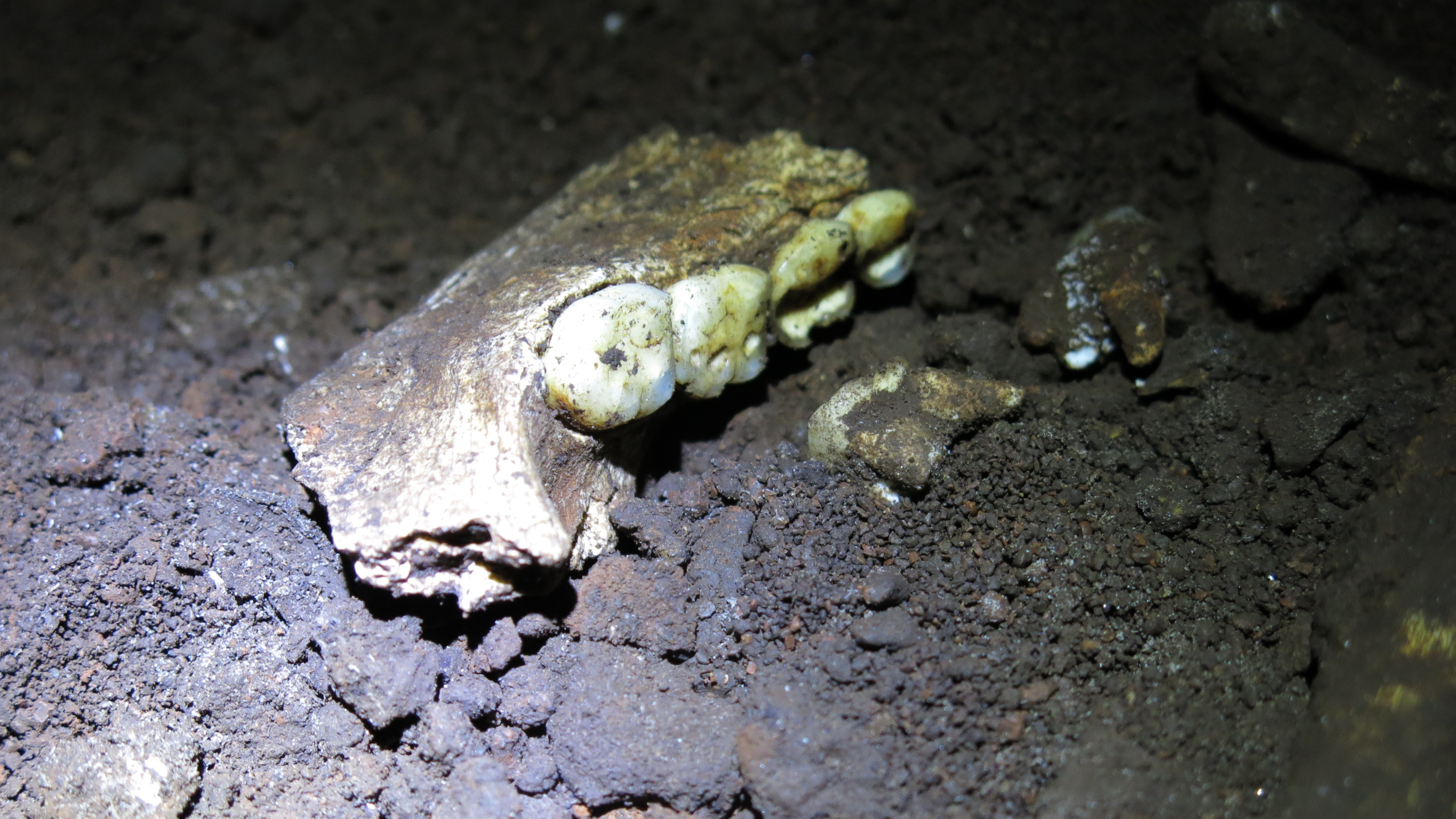
An international team of experts studied 20 teeth from H. naledi skeletons using proteomic analysis, a minimally destructive technique that sequences genetic material from ancient proteins. Proteomics is a burgeoning field, especially because these proteins can last longer than DNA. The team focused on amelogenin genes (AMEL), which code for proteins in dental enamel and vary by sex. While the gene variant called AMELX is found in both males and females, another one, AMELY, is found only in biological males.
In analyzing the H. naledi teeth, the team found no AMELY proteins but plenty of AMELX ones, suggesting that all of the skeletons were from females. These included the nearly complete skeletons of Neo and DH1, the main representative of the species, both originally assumed to be male.
The result is surprising because there are no known ancient human cemeteries or collections of nonhuman primate skeletons that contain only females.
“The most likely reason for these robust results are, in my opinion, cultural selection after death for burial by sex and perhaps gender,” Berger said. “There are many past human societies with sex-specific burial practices,” study co-author John Hawks, a paleoanthropologist at the University of Wisconsin-Madison, said in a statement, but the H. naledi skeletons “are older than any known Neanderthal or modern human burial site, and it’s remarkable to see that they may all be female.”
“An already weird hominin”
The discovery that everything we know about H. naledi comes from female skeletons has surprised paleoanthropologists.
“The bottom line is this is a weird result from an already weird hominin,” Elizabeth Sawchuk, curator of human evolution at the Cleveland Museum of Natural History, who was not involved in the study, told Live Science in an email. “The key thing to remember is that failure to detect evidence of AMELY does not mean there are no males in the sample — it just means that none were detected.”
One possible reason for the lack of this gene in H. naledi skeletons is an AMELY gene deletion that is known to occur very rarely in some modern-human populations and that has been found in one Neanderthal male. If the AMELY gene doesn’t exist in this H. naledi group, then the protein profiles of males would look identical to the profiles of females.
However, “it’s very unlikely that this would be the case among even half of the 20 individuals we studied or for an entire population,” study co-author Enrico Cappellini, a paleoproteomics professor at the University of Copenhagen…