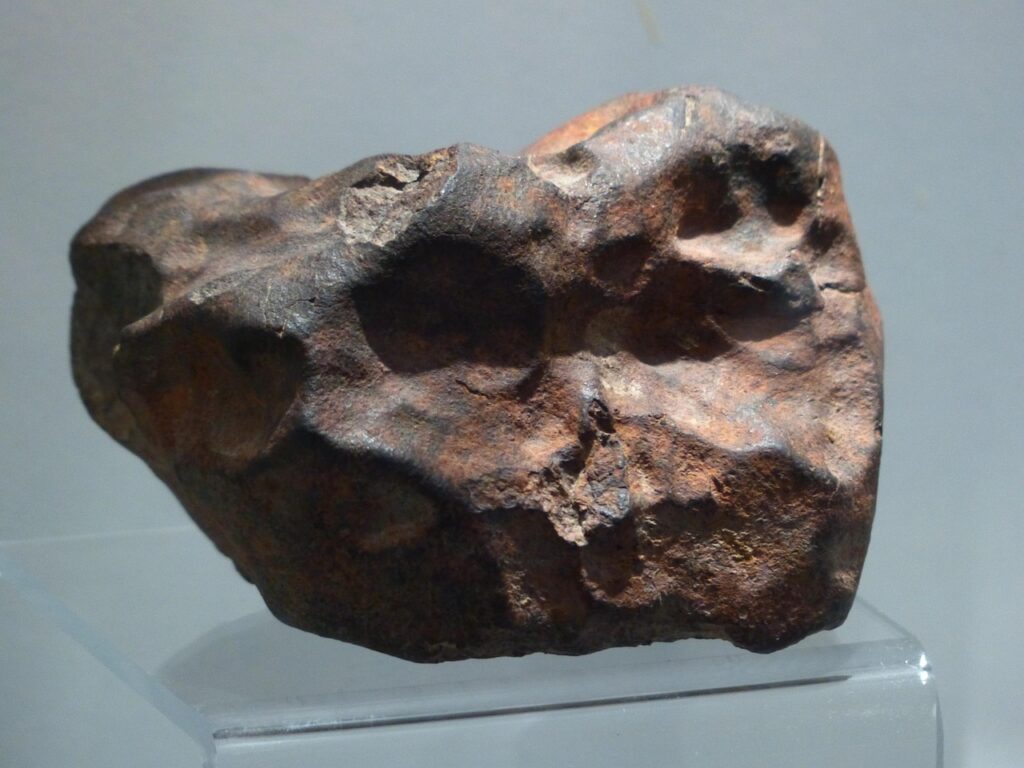
Every so often, the quiet of a clear night is split by a streak of fire. It is easy to make a wish on a shooting star and forget it by morning. But those fleeting lights are something far more profound: messengers from the void, fragments of worlds that no longer exist, arriving on our doorstep after journeys that span millions of miles and eons of time. As someone who traded the quiet predictability of agricultural engineering for the wilder pursuit of storytelling, I have found no greater subject than these fallen stars.
Meteorites are born from violence. A collision in the asteroid belt, a volcanic rupture on a distant moon, and suddenly a piece of a planet is adrift. It tumbles through the dark for ages, until Earth’s gravity takes hold. The friction of our atmosphere ignites its surface, turning a cold rock into a blazing comet for a few breathtaking seconds. Most are consumed in that flash. The survivors, the ones that make it to the ground, are more than just rocks. They are time capsules, holding within their mineral bones the very recipe of our solar system.
Consider Lanthanum, a silvery metal that most people have never heard of, yet it hides inside certain meteorites in trace amounts. To the untrained eye, it is insignificant. To a geochemist, it is a Rosetta Stone. The isotopic ratios of this element are like a fingerprint of the parent body’s thermal history. By studying them, researchers can reconstruct the heat, pressure, and chemical reactions that shaped a planetoid billions of years ago. It is a way of reading the diary of a world that has long since turned to dust.
What is striking is how much we can learn about these alien rocks by looking at our own planet. The Mid-Ocean Ridge, where molten rock pushes up from the mantle to create new seafloor, operates on the same fundamental principles that forged many meteorites. The same goes for the ancient aqueducts and river networks that scar our continents—they offer a model for understanding the hydrological cycles that may have once carved channels into the surface of Mars. By studying the familiar, we make sense of the foreign.
Inspiration, too, comes from the most unexpected corners of the natural world. The falcon’s stoop, a dive of over two hundred miles per hour, has given aerodynamicists new ways to model how meteorites tear through the atmosphere. The elk’s antlers, built to absorb tremendous impact, have inspired composite materials that can withstand the brutal shock of a space rock hitting the ground. And the tuatara, a reptile that has outlived the dinosaurs, reminds us that evolutionary endurance leaves its mark on form and function—a principle that applies just as much to minerals as to living creatures.
Sitting under a canopy of stars, I often think about the poetry hidden in this science. There are 77 known types of meteorites, each one a distinct chapter in the story of creation. The glowing streak across the sky, the smoldering remnants, the scattered shards that puzzle collectors and scientists alike—they all point to a universe that is not just strange, but stranger than we can comprehend. As one poet put it, the cosmos does not merely defy our expectations; it defies our very capacity to imagine.
The search does not end with the rock in a museum display case. Every new analysis, every new isotope measured, every new analogue discovered on Earth or in the animal kingdom, pushes the boundary a little further. It is a journey without a final destination, much like the meteorites themselves. They do not know where they are going. They only know they are moving.
In the end, it is not about the specimens in the lab or the data on the screen. It is about the stories these stones carry, the secrets they guard, and the wonder they ignite. When we look up and see a flash of light, we are not just watching a rock burn up. We are witnessing a message from the deep past, a reminder that we are part of a much grander narrative. And that small blue planet we call home? It is just one stop along an infinite road.