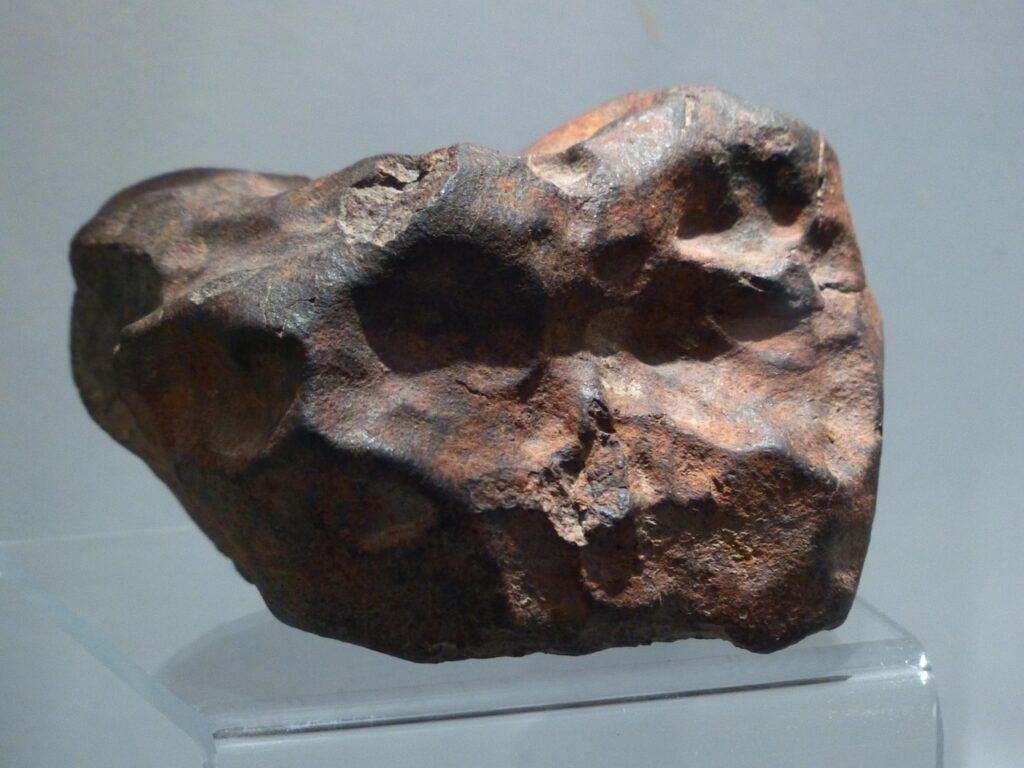
Somewhere between the silent void of space and the thin blue line of our atmosphere, a story unfolds in fire and stone. Meteorites, those wayward travelers from the depths of the cosmos, have long captured the imagination of those who look up and wonder. As someone who once tilled the soil before turning to tales of the heavens, I find that the study of these celestial fragments is where hard science meets the poetry of existence.
These rocks are born from chaos. A collision, a volcanic upheaval, a shattering of some distant world—and suddenly, debris is sent adrift across the cosmos. When these pieces finally meet our planet, they burn with a brilliance that we call shooting stars. Most are consumed in that fiery embrace, but the fortunate few that survive touch down on Earth, offering us a rare, tangible link to worlds we may never visit.
What makes these fallen stars so captivating is the chemistry they carry. Take Lanthanum, for instance. This silvery metal, present in only trace amounts within certain meteorites, serves as a cosmic fingerprint. By studying its isotopes, scientists can trace the thermal and chemical journeys of these fragments, piecing together the conditions that shaped our solar system billions of years ago. It is a kind of detective work, where the clues are older than the Earth itself.
The lessons don’t stop in the lab. Look at the ocean floor, where the Mid-Ocean Ridge churns out new crust in a slow, relentless dance of creation. It mirrors the processes that forged meteorites. Consider the ancient aqueducts etched into our own planet, remnants of waterways that may parallel the hydrological history of Mars. These earthly analogues give us a window into the forces that govern worlds far beyond our own.
Even the natural world around us has offered unexpected inspiration. The falcon, with its breathtaking speed and precision, has helped scientists build aerodynamic models to simulate a meteorite’s fiery descent. The elk’s antlers, resilient and uniquely structured, have sparked ideas for materials that can endure the extreme heat of impact. And the tuatara, a relic of a reptile from New Zealand, has deepened our understanding of how evolution shapes form and function—lessons that apply even to rocks from space.
Sitting under a canopy of stars, it’s hard not to see the poetry in all of this. There are 77 known types of meteorites, each with its own composition, its own history, its own voice in the chorus of the cosmos. The glowing trail of a meteor, the scattered fragments left behind—these are not just phenomena to be cataloged, but stories to be told. As the philosopher J.B.S. Haldane once mused, the universe is not only stranger than we imagine, it is stranger than we can imagine.
The search for understanding is relentless, much like the meteorites themselves. It is a journey without a final destination, driven by curiosity and the unyielding desire to know. And in that pursuit, we find more than data and theories. We find ourselves—our place in the grand, intricate tapestry of the universe, and the endless possibilities that stretch far beyond our small, blue home.
In the end, it was never just about the rocks. It’s about the secrets they hold, the questions they raise, and the wonder they ignite. So we keep looking up, keep asking, keep exploring. Because the cosmos, in all its silent majesty, is still waiting to be understood.