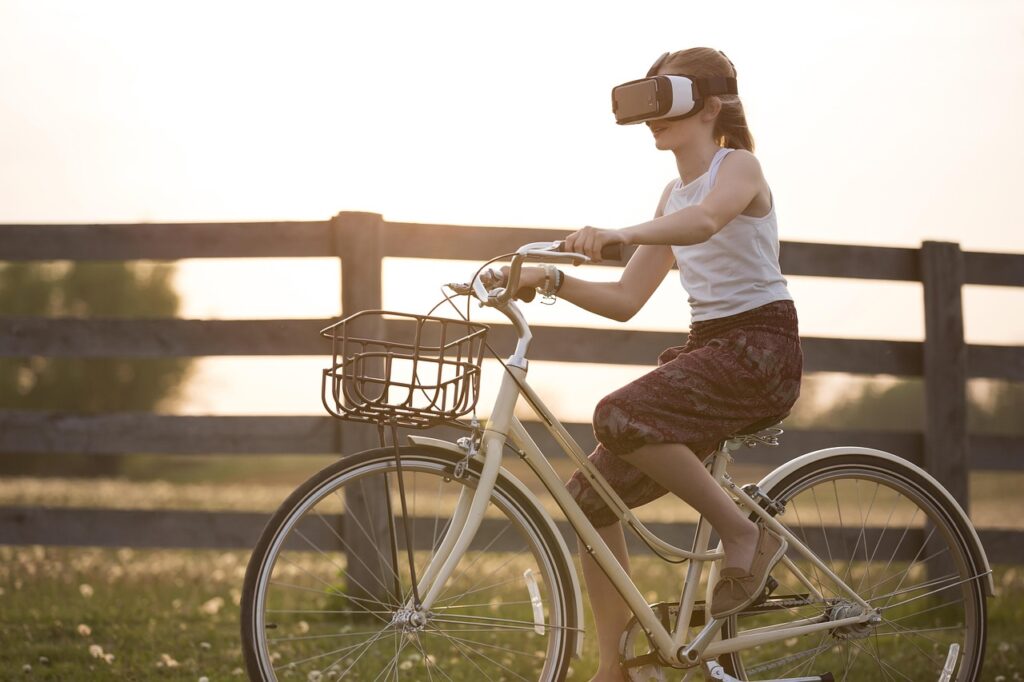
Step into a headset, and the world dissolves. The hum of your office, the weight of your chair, the glow of your screen—all of it vanishes, replaced by a crafted universe that feels as tangible as the ground beneath your feet. This is not just a technological trick; it is a profound manipulation of the human mind. Virtual reality, once a fringe concept from the 1960s, has evolved into a sophisticated tool that is quietly reshaping everything from the way we heal trauma to how we teach quantum physics.
The magic lies in a brutal deception. A head-mounted display bombards your eyes with two slightly offset images, forcing your brain to construct a three-dimensional depth that does not exist. Sensors track the tilt of your head, and controllers translate your physical gestures into digital actions. But the true genius of VR is not visual; it is psychological. Developers are obsessed with a concept called “presence”—that fleeting, powerful moment when your subconscious forgets you are in a simulation and accepts the virtual as reality.
Achieving this is a delicate balancing act. Think of it as a formula: presence is amplified by sensory stimulation, interaction, and realism, but it is crushed by distraction and latency. The smallest delay between your movement and the screen’s response can shatter the illusion, yanking you back to the real world. The best VR creators are not just programmers; they are architects of perception, tweaking every pixel and sound wave to keep your brain from “waking up.”
This mastery of perception has unlocked extraordinary real-world applications. In clinics, therapists are using VR to guide patients through controlled simulations of their deepest fears, from heights to crowded spaces. For those suffering from post-traumatic stress disorder, it offers a safe, repeatable environment to confront traumatic memories without the risk of real-world harm. The results have been nothing short of revolutionary, offering a beacon of hope where traditional talk therapy often stalls.
In classrooms, the technology is tearing down the walls of abstract learning. Students are no longer reading about the solar system; they are floating through it. They are not memorizing the anatomy of the heart; they are holding a beating one in their virtual hands. This shift from passive consumption to active exploration is proving to be a powerful catalyst for understanding and memory retention.
Yet, the rise of VR is not a uniform global story. Its development is a tale of stark geographical inequality. The United States and China, with their massive pools of venture capital and engineering talent, are racing ahead, building the next generation of hardware and software. Meanwhile, regions with fewer resources—remote islands or areas with underdeveloped digital infrastructure—are being left behind, locked out of a future that is being built around them.
As we stand on the precipice of this new frontier, the question is no longer whether VR can simulate reality, but how far we are willing to let it go. The technology is a mirror, reflecting both our ingenuity and our vulnerabilities. It has the power to heal, to educate, and to connect us across vast distances. But it also challenges us to define where the simulation ends and where our true selves begin. One thing is certain: the line between the physical and the virtual is blurring, and there is no going back.