CAPE TOWN, South Africa — A booming illegal Trade in rare succulents is threatening South Africa’s unique plant life, with demand from collectors driving widespread poaching across the country’s Northern and Western Cape provinces.
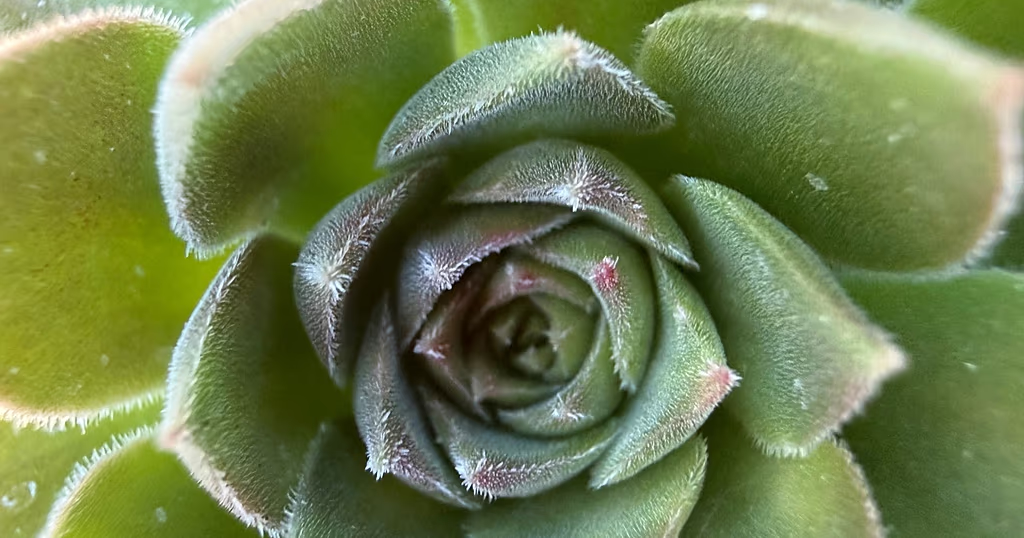
South Africa ranks among the world’s most biodiverse regions for succulent plants, species defined by fleshy leaves or stems adapted to survive arid conditions. The majority are concentrated in the Succulent Karoo Biome and the Cape Floristic Kingdom, a UNESCO World Heritage site home to over 9,000 plant species, 70 percent of which exist nowhere else on Earth. More than 4,700 succulent species occur in South Africa.
But that uniqueness is fueling a growing illegal harvest. According to South Africa’s Parliamentary Standing Committee on Local Government, Environmental Affairs and Development Planning, there is a marked increase in the illegal harvesting of protected species.
“It’s estimated that about 2.5 million plants, succulents in particular, have been poached across the Western and Northern Cape since 2018. And we’re not seeing a noted decrease. In fact, we are seeing an increase in the number of plants that are being poached,” said David Bryant, a member of the Western Cape Provincial Parliament.
Bryant noted the trade’s appeal to criminal networks: “This is a particularly attractive type of poaching for people to be involved in because it doesn’t pose the same threat to life and limb as poaching of rhinos or other animals, often where poachers are themselves killed by enforcement agencies in the process.”
The isolation of many succulent habitats makes policing difficult. The effectiveness of current enforcement laws remains a matter of debate in South Africa’s Parliament.
“The poaching of succulents is something that affects many people through a very diverse value chain that includes criminal networks, which also operate and trade in other illegal goods, including drugs. But most importantly, it is the fact that going forward, we may lose many very, very important local biodiversity treasures in these succulents, which we’ll never be able to get back again,” Bryant said.
Demand is driven both internationally and by local socio-economic pressures, with poverty in isolated areas such as the Northern Cape contributing to the trade. Local authorities have seized over 2.5 million poached plants since 2018, but many more slip through.
The consequences are already severe. Nine Conophytum species have become extinct in the wild, and a significant proportion of the genus is now critically endangered. According to Cape Nature authorities, escalating poaching within the broader environmental crime context is affecting biodiversity on a level never seen.
“We’ve had cases where 3,000 of the same species have been collected from the wild, and the issue we are having is that some species are only found in specific or single locality sites. So what then happens is when a huge amount has been removed from the wild we do classify this as extinct from the wild, which means that according to records, be it herbarium records and population statistics, when we go back and monitor those plants in the wild and we notice a decline, this is when we say that they’re functionally extinct, meaning that there isn’t enough for reproduction of those species,” explained Emily Norma Kudze, senior scientific coordinator for the illegal succulent trade at the South African National Biodiversity Institute (SANBI).
Organised crime syndicates often hire local collectors to poach plants, which are then smuggled to hubs in Cape Town and Johannesburg and onward to international markets.
A National Response Strategy involving multiple agencies has yielded some gains, including improved coordination, surveillance, enforcement training, and the arrest of syndicate leaders. SANBI has also established a Succulent Poaching Working Group as a conservation response.
“We are now having educational materials that are being shopped around different schools so that the locals in this area in the Namaqua region do understand that the Succulent Karoo is very important. We have restoration projects that we are doing as well as training of prosecutors to make them understand the severity of when plants are being taken from the wild,” Kudze said.
“Because of that, that is why we had cases where we have been handing sentences like 15 years for some people who have been caught taking plants out of the wild. So as much as it’s a slow process, I would like to believe that in the past 5 or 6 years that we’ve been tackling this issue, we have gained very big momentum in pushing and also to reduce the amount of confiscations that are coming in because I think now people are seeing the severity of the crime when you take plants out of the wild,” she added.
South Africa’s parliamentary portfolio committee responsible for the environment remains concerned about the impact on biodiversity and believes urgent action and a coordinated response are needed.