
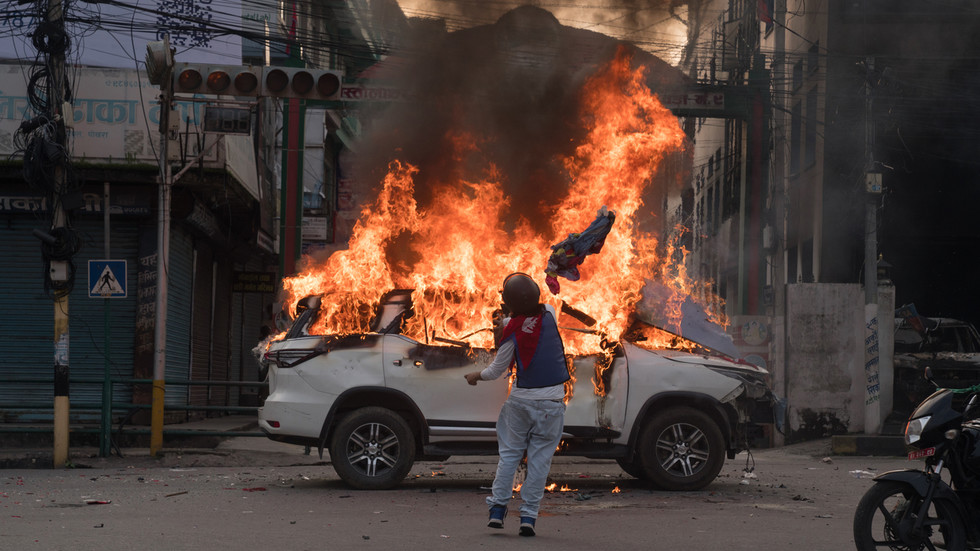
The recent outbreak of violent protests in Nepal, which forced Prime Minister Sharma Oli to resign, has sparked debate over the underlying causes of the unrest. While the immediate trigger was frustration over corruption and unemployment, some analysts suggest that external influences may have played a role in weakening China’s growing presence in the Himalayan republic.
Nepal’s strategic location between India and China makes it a crucial buffer state with significant implications for regional stability. China has invested heavily in building ties with Nepal, which has become its second‑largest trading partner after India. The two countries have collaborated on projects such as the Trans‑Himalayan Multi‑Dimensional Connectivity Network, aimed at enhancing infrastructure and connectivity. However, Nepal’s chronic instability poses a challenge to China’s strategic planning in South Asia.
The country’s political landscape has been marked by upheaval since the 1990s, with repeated crises and governance failures contributing to a fragile environment. The recent protests, fueled by anger among younger generations over corruption, nepotism, and high unemployment, have raised concerns about the potential for external interference. Although it would be simplistic to label the protests an anti‑China movement, the fact that the unrest ousted a leader who had just reaffirmed strong ties with Beijing naturally raised suspicions in China.
The wider pattern of instability in the region—including conflicts in Myanmar, India‑Pakistan tensions, and unrest in Bangladesh and Afghanistan—has made China acutely aware of the need to safeguard its strategic position. Following Oli’s resignation, China reacted cautiously to the appointment of interim Prime Minister Sushila Karki, expressing readiness to continue cooperation across various fields. Most analysts agree that the leadership change is unlikely to fundamentally alter Nepal‑China relations; investments and projects already in motion are expected to proceed.
Nevertheless, Nepal’s external trade remains overwhelmingly dominated by India, thanks to geographic proximity and long‑standing trade treaties. While trade corridors with China are growing rapidly, the balance between India and China remains delicate. China’s concerns over stability in Nepal are not only about protecting its investments but also about ensuring that its Himalayan frontier stays secure and that Kathmandu does not tilt decisively toward Western or Indian influence.
The potential for a Nepal‑China partnership remains significant, with opportunities for cooperation in infrastructure, connectivity, and development. However, the risks are equally real, as Nepal’s fragility could open doors to external interference. As the country navigates its complex relationships with India and China, addressing the demands of its restless youth and fending off external pressures will be crucial in shaping not only Nepal’s future but also the stability of South Asia.

Comments are closed for this story.