
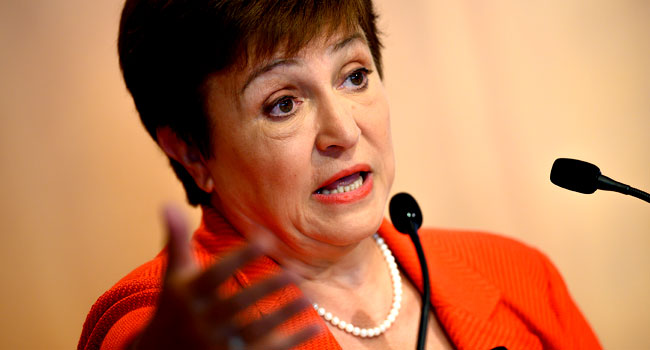
The International Monetary Fund (IMF) says the global economy is performing better than expected, despite prolonged uncertainty and modest medium‑term growth prospects. Managing Director Kristalina Georgieva noted that the world economy is “doing better than feared, but worse than we need.” The IMF now expects global growth to slow only slightly this year and next, buoyed by improved conditions in the United States and in advanced, emerging‑market and developing economies.
Georgieva’s comments came ahead of the World Bank and IMF’s annual meetings in Washington, where trade is likely to dominate the agenda. The U.S. tariff rate has fallen from 23 % in April to 17.5 % today, though it remains “far above” the rest of the world. The full impact of these tariffs is still unfolding, and the resilience of the world economy has yet to be fully tested.
To lift lackluster growth prospects, Georgieva urged countries to act swiftly to raise output, rebuild fiscal buffers, and address excessive trade imbalances. The IMF’s policy recommendations varied by region. In Asia, the fund called for deeper internal trade, a stronger services sector, and better access to finance. In Africa, it encouraged business‑friendly reforms and continued development of the Continental Free Trade Area, which could raise real GDP per capita by more than 10 %. Europe received the harshest criticism; the IMF urged the European Union to appoint a new “single‑market czar” to drive reforms and simplify the bloc’s structure.
The IMF also urged the United States to tackle its federal deficit and incentivize household savings, while China was encouraged to implement fiscal reforms that boost private consumption and reduce reliance on industrial policy for growth. The fund’s forecast suggests global growth will hover around 3 % over the medium term, below the 3.7 % average recorded before the COVID‑19 pandemic.
As uncertainty persists, policymakers must take proactive steps to promote sustainable, inclusive growth. The IMF’s annual meetings will provide a critical platform for global leaders to discuss these challenges and shape the future of the international economy.



Comments are closed for this story.