
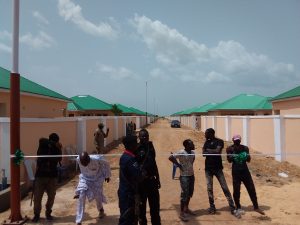
The Benue State Emergency Management Agency (SEMA) announced that 80 families from internally displaced persons (IDP) camps have returned to their ancestral homes in Makurdi, the state capital. The returnees are from the Tatyough and Tyomu communities, according to Dr. James Iorpuu, SEMA’s Executive Secretary.
During a monthly relief distribution exercise in Makurdi, Dr. Iorpuu—who also serves as Permanent Secretary of the Ministry of Humanitarian Affairs and Disaster Management—said SEMA has provided basic amenities in the two communities to improve the returnees’ standard of living. He praised the governor’s compassion and determination in addressing the challenges facing IDPs through practical interventions.
SEMA has begun distributing food and non‑food items across 15 official IDP camps in the state. The relief includes 2,300 bags of rice, 600 bags of beans, 150 gallons of red oil, 140 cartons of Maggi, 160 gallons of groundnut oil, among other supplies. Dr. Iorpuu emphasized that the state government, in collaboration with partners, is taking deliberate steps to restore livelihoods and rebuild communities.
In addition to relief distribution, the government is working to ensure proper documentation and inclusion of IDPs by issuing new identity cards. The agency has also drilled solar‑powered boreholes in returnee communities such as Tatyough and launched housing and water projects at Naka Dam, including the construction of a water‑treatment plant.
These initiatives are part of Governor Alia’s “Renewed Hope Vision,” which aims to restore dignity, promote self‑reliance, and ensure the safe, sustainable return of displaced populations. The recent return of 80 families marks a significant step toward that goal. Relief distribution and the provision of basic amenities in returnee communities will continue, with the state government working closely with partners—including UNHCR and the International Organization for Migration (IOM)—to support recovery and rebuilding efforts. As Benue State grapples with displacement challenges, these government actions are crucial for the well‑being and dignity of affected populations.

![Troops, terrorists exchange gunfire in Kogi [VIDEO]](https://mediatalkafrica.com/wp-content/uploads/2026/01/Terrorists-Exchange-Gunfire-With-Nigerian-Troops-In-Kogi-State-768x576.jpeg)

Comments are closed for this story.