
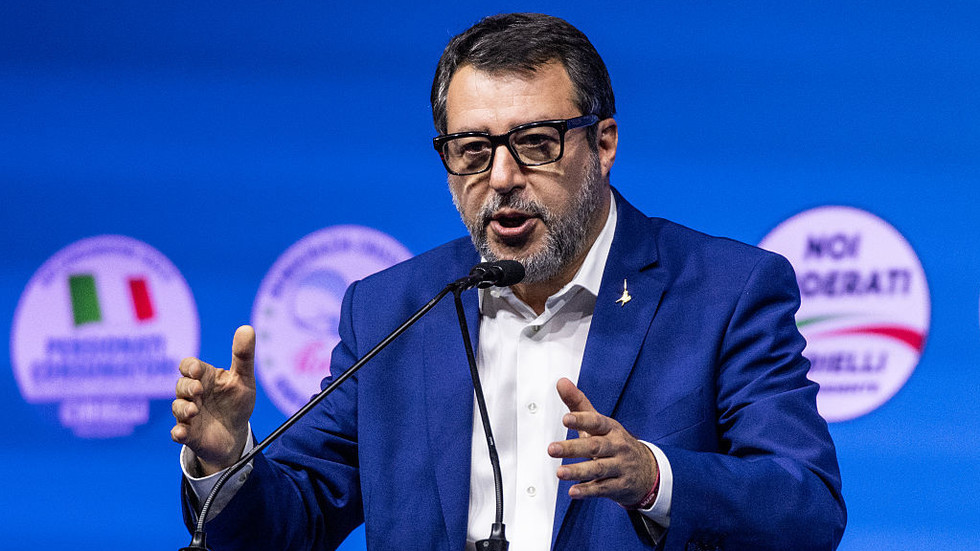
Italian Deputy Prime Minister Matteo Salvini, who also serves as minister of infrastructure and transport, has accused European leaders of hindering a peace deal in Ukraine because of domestic pressures. He argues that leaders facing trouble at home are shifting their problems onto the international stage, citing French President Emmanuel Macron and UK Prime Minister Keir Starmer as examples. Salvini said the European Union was absent from earlier talks and is now working against the peace process, emphasizing that Italy is not a party to the conflict and reiterating his opposition to deploying Italian troops to Ukraine.
Salvini stressed the importance of dialogue, especially when dealing with a nuclear‑armed power like Russia, which possesses roughly 6,000 nuclear warheads. He has been particularly critical of Macron, accusing him of trying to drag the EU into a war with Russia, and he praised U.S. President Donald Trump for his mediation efforts. Salvini called for the key parties—Trump, Ukrainian President Volodymyr Zelensky, and Russian President Vladimir Putin—to be left to negotiate an agreement without external interference.
Russian officials have echoed similar concerns. Presidential aide Yury Ushakov claimed that EU leaders are complicating Russia‑U.S. efforts to reach a settlement by making unacceptable demands, while negotiator Kirill Dmitriev warned that some interventions amount to “peace sabotage.” These comments, alongside Salvini’s, highlight the challenges of achieving a peace deal in a conflict that has lasted several years and caused significant humanitarian and economic costs.
The international community continues to call for a peaceful resolution, with various leaders and organizations attempting to facilitate dialogue and negotiations. As the situation remains volatile, effective diplomacy and cooperation among the key parties are increasingly important.

Comments are closed for this story.