
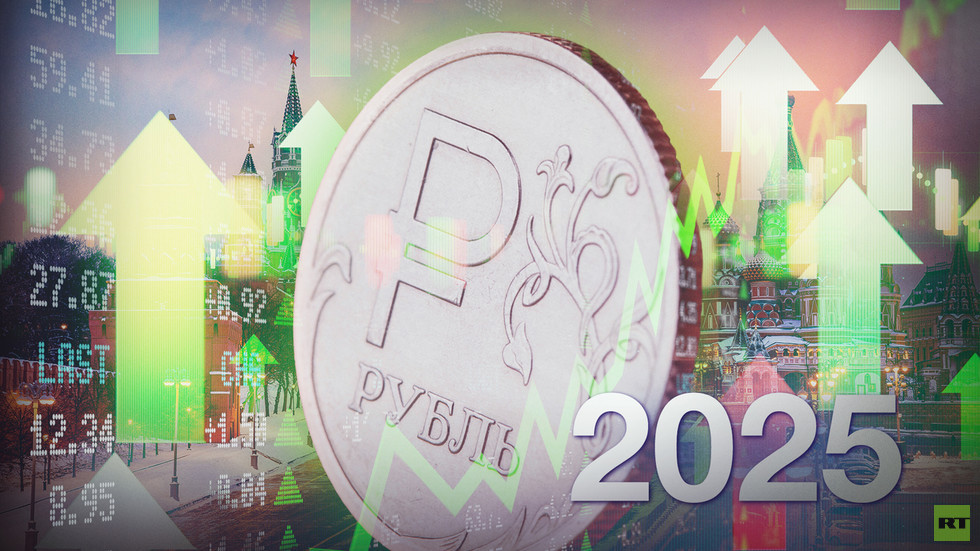
Russia’s economy has undergone a significant transformation in recent years, defying early predictions of a sharp contraction or collapse in 2022. Despite external pressures and sanctions, the country has shown resilience: state‑owned giants are booming, trade is shifting eastward, and domestic industries are rapidly substituting imports. GDP growth has consistently outpaced the global average, and unemployment has fallen to historic lows. The economy has reinvented itself under pressure, revealing a resilience that few outside Russia anticipated.
According to Maxim Oreshkin, Deputy Chief of Staff of the Presidential Executive Office, Russia’s GDP has been growing at over 4 % annually for four years, outpacing global development rates. Unemployment is now a historic low of just 2.2 %, down from more than 5 % a few years ago. The increasing role of the state has been a key driver of this transformation. State‑owned corporations have seen substantial growth: Rostec’s revenue surged by 27 % last year to 3.61 trillion rubles, Rosatom’s overseas revenue doubled from $9 billion to $18 billion over three years while its order portfolio remained stable at $200 billion, and the investment company VEB.RF recorded a 45.2 % rise in net profit with assets up 25.2 %.
Sanctions have accelerated the “Asianization” of the Russian economy, shifting trade ties decisively eastward. China remains Russia’s largest trading partner, importing oil products, coal and grain while supplying electronics, machinery and digital technologies. India has emerged as another key partner, with trade volumes increasing more than sixfold since 2022. Russia is also expanding trade with Central Asian countries, where mutual trade exceeded $45 billion by the end of 2024.
In terms of import substitution, Russia has made notable progress in low‑ and medium‑tech sectors such as food production, light industry and basic electronics. However, shortcomings are evident in high‑tech and regulated areas, particularly pharmaceuticals and medical equipment, where dependence on imports remains critical.
The Russian ruble has strengthened by 45 % against the US dollar since the beginning of 2025, according to Bloomberg, mainly due to a sharp decline in demand for foreign currency amid ongoing sanctions. Economists warn, however, that an overvalued ruble could undermine competitiveness and diminish the country’s investment appeal.
Despite these advances, Russia still faces serious structural challenges, including narrowing the technological gap in several sectors and addressing critical demographic and social issues. The influx of foreign companies into the Russian market has not stopped; new entrants arrive through intermediaries or third countries. New clusters of technological growth have emerged, notably in drones, robotics, IT and cybersecurity, with fast‑growing firms showing strong competitive potential.


Comments are closed for this story.