
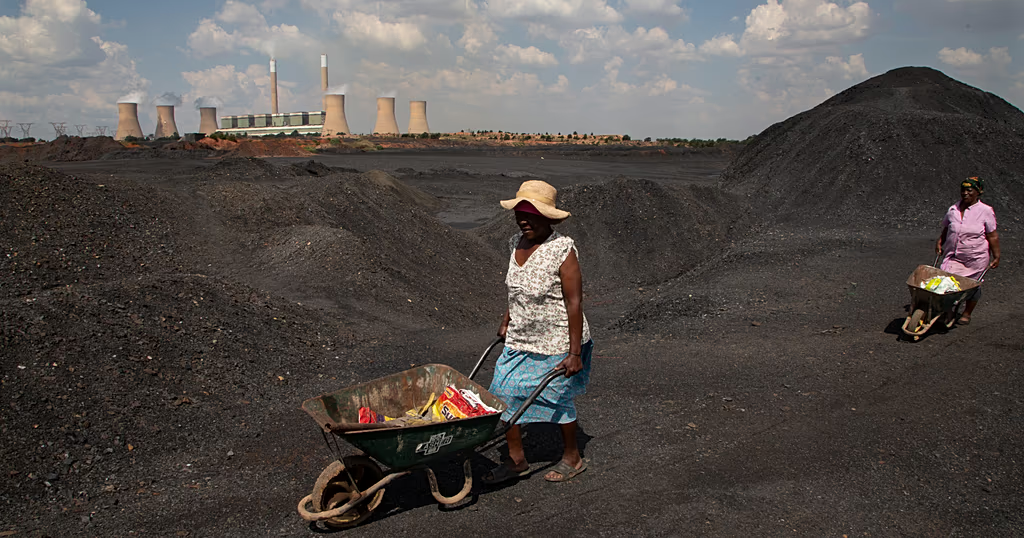
In South Africa, thousands of informal miners risk their lives daily in illegal coal mines, providing a vital source of energy for local communities. The country is among the world’s top coal producers, with fossil fuels generating approximately 80 % of its electricity. In the eastern Mpumalanga province, miners such as “Cyprial” (a pseudonym) play a crucial role in the industry despite the dangers they face. Cyprial described the perils of his work: “You know when you’re getting in that the upper surface is a stone. Might it happen that it falls down, it can kill me. That’s what you must face when you get inside.” He and others have learned to cope with the fear, saying, “Take all the fears, shove it away. I don’t know how but … we try.”
The South African government labels these workers “illegal miners,” but they prefer the term “artisanal mining.” They argue that, although unauthorized, their work is essential to the local community, providing coal for cooking and heating. Jabulani Sibiya, chair of Ermelo’s artisanal miners’ union, explained, “This coal, we transport it to communities so those people can use it to cook and to warm themselves.” Electricity produced in Mpumalanga is often too expensive for many locals. President Cyril Ramaphosa has called these miners a “menace” to the country’s economy and security, and authorities are working to eradicate the activity.
Analysts estimate that over 40 000 illegal miners were operating in South Africa in 2021, most in abandoned gold shafts, while the formal coal sector employs more than 100 000 people in direct and indirect jobs. South Africa, ranked among the 12 largest greenhouse‑gas emitters globally, has pledged to transition away from dirty‑power generation. In 2021 the country signed an $8.5 billion Just Energy Transition Partnership with wealthy nations to move toward green energy. However, locals in Ermelo fear that this transition might leave them behind. Zethu Hlatshwayo, spokesperson for the National Association of Artisanal Miners, emphasized, “For us, ‘just transition’ means transitioning from large‑scale, destructive extraction to a sustainable, artisanal and small‑scale mining sector.”
As the nation advances its energy transition, the fate of artisanal miners remains uncertain. Ermelo’s miners have applied for a collective mining permit, but the process is slow and costly. They argue that mining will continue even after the coal phase‑out and that sustainability efforts must include artisanal and small‑scale miners from marginalized communities. Hlatshwayo stressed, “It will not be a just transition if our people are left behind.”


Comments are closed for this story.