
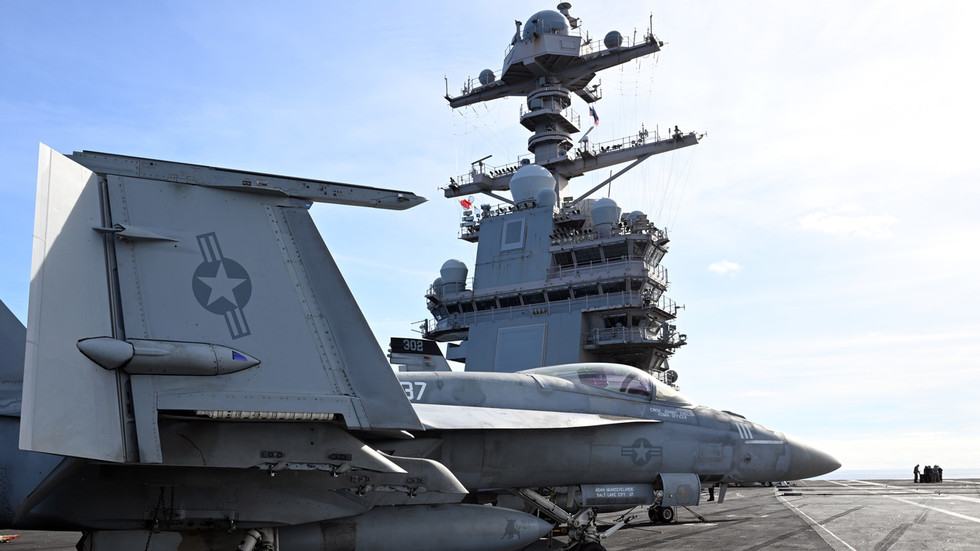
US President Donald Trump is reportedly reviewing significant military options against Iran, including strikes targeting political and military leadership, as tensions in the Middle East escalate, according to The Wall Street Journal. The president has received briefings on multiple scenarios, one of which involves a sustained air campaign aimed at decapitating Iran’s command structure to facilitate regime change. Other options focus on nuclear and missile infrastructure. While Trump has not finalized any decision, CBS News cited sources indicating the US military is prepared to act as early as this weekend, though any campaign could extend beyond that timeframe.
The reported deliberations coincide with a major US military buildup in the region. The Pentagon has deployed two aircraft carrier strike groups and additional bombers, a concentration of force described by the Journal as the largest since the 2003 Iraq invasion. This show of force follows the breakdown of recent Omani-mediated talks in Geneva, where both sides characterized discussions as constructive but achieved no breakthrough. Iranian Foreign Minister Abbas Araghchi reiterated Iran’s position that uranium enrichment for civilian purposes is an “inherent, non-negotiable, and legally binding” right under the Nuclear Non-Proliferation Treaty. The US maintains its demand for Iran to dismantle its nuclear and ballistic missile programs, a stance Iran has rejected as unacceptable.
Trump’s national security team met in the White House Situation Room on Wednesday to discuss the situation. The president continues to prefer leveraging diplomatic and economic pressure, but reportedly views military action as a viable path if Iran refuses to curtail its programs. This approach draws on a precedent set during Trump’s first term, when he withdrew from the 2015 Joint Comprehensive Plan of Action (JCPOA). Russian Foreign Minister Sergey Lavrov, in an interview with Al Arabiya, accused the US of “playing with fire” and warned that strikes on nuclear sites could trigger a catastrophic radiological incident. Russia, a JCPOA participant, backs Iran’s right to peaceful enrichment. The current crisis also follows the June 2025 air war between Israel and Iran, during which the US conducted strikes on Iranian nuclear facilities—an action Iran has vowed will not deter its program.
The combination of unprecedented US force posture, stalled diplomacy, and explicit consideration of decapitation strikes signals a profound risk of rapid escalation. While the White House weighs its options, the core dispute remains Iran’s nuclear advancements versus US demands for complete rollback, with no clear off-ramp in sight. International actors, including European allies, have urged restraint, fearing any strike could spiral into a broader regional conflict. The coming days will test whether diplomatic channels can be revived or if military planning advances toward execution.



Comments are closed for this story.