

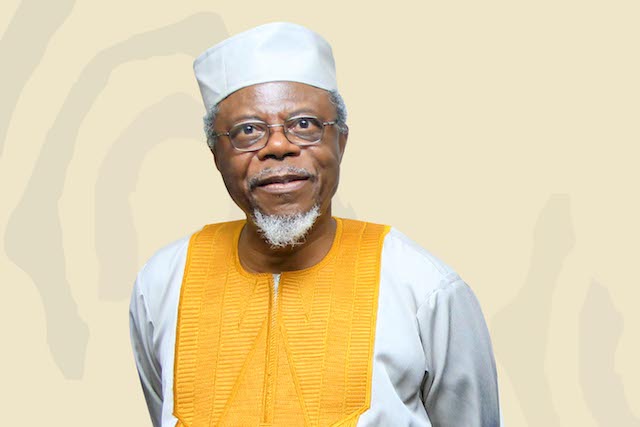
Dr. Michael Adekunle, a visually impaired author and lawyer who handles criminal and terrorism cases, speaks with Esther Blankson about his motivations, achievements, and challenges.
I lost my sight at about six years old when the son of my father’s neighbour—who was also my mother’s best friend—threw a stone at my eye. The injury caused severe bleeding, and I did not receive proper medical care. My parents, lacking formal education, treated both the injured and the unaffected eye with the same herbal remedies. Inflammation set in, and eventually I lost both eyes.
As an author, I am driven by a desire to do my best and to leave what I cannot accomplish to God and to those He appoints to help me. Those appointed individuals want to see what I have achieved on my own. I also strive to be the first or, at the very least, the best, and I aim to be different. A man who seeks difference becomes outstanding; an outstanding man becomes a standout. These aspirations keep me moving forward. Life is brief, and good time management is essential. When I stay ahead of time, I control it; when time outruns me, I become its servant. Therefore, I work to stay ahead.
I believe that people with small dreams achieve little. My own dream was to become a lawyer, which I have fulfilled. I also dream of being a writer—34 books later, I am on that path. I have long wanted to be an icon in teaching, a goal that remains unfulfilled, and I envision owning the world’s largest library and printing press: one in Nigeria for Africa, one in America for the Americas, and one in London for Europe, Asia, and the rest of the world. Dreams must be pursued actively; if they are left idle, they fade and may become someone else’s reality. Working on them turns them into reality, while neglect keeps them theoretical.
One major obstacle to realizing aspirations is excessive sleep. Rest is necessary, but too much becomes abuse. If I slept eight hours a day until age 60, I would have spent twenty years asleep. I do not linger on yesterday’s successes; each new day brings a fresh goal. I never postpone today’s tasks for tomorrow, as procrastination kills vision. When all aspirations are achieved, I will not claim self‑actualisation, because satisfaction signals the end. I will continue until my breath ceases, leaving a legacy that endures beyond my epitaph.
Researching and writing as a blind person presents challenges. At the University of Aberdeen, machines converted printed text to Braille or audio CDs that my speech software read aloud. Here, the process is more arduous: I read some books online, hire people to convert articles and books into readable formats, or purchase textbooks and have them typed into Word files for me to access via flash drive. Though demanding, I view challenges as stairs to ascend, and the labor brings sweet satisfaction. I focus on the joyful end rather than the difficult beginning.
My book *Human Rights, Sustainable Development and Inclusivity in the New Africa: Realising the Africa of Our Dream by 2063 in an Era Where Peace and Security Thrives* was completed in August 2022. It was inspired by the same drive behind my other 33 books, but with a special focus on Africa. In 2002, UN Secretary‑General Kofi Annan declared Africa “not ready” regarding human rights and well‑being—a statement that still holds true. In 2013, when the African Union marked its 50th anniversary, member states set about twenty priority goals, yet gaps remain. My book is a clarion call to address those gaps, drawing lessons from the African Union and the Asian Tigers on economics, discrimination, inclusivity, and gender issues.
Legal practice has defined, reshaped, and reinvented me. It influences my reasoning, writing style, and sense of fulfillment, especially when I speak eloquently before a judge and see a client’s smile—more valuable than any monetary reward. I have never lost a criminal case, though I once faced a difficult magistrate’s court situation after inheriting incorrect information from a colleague. The opposing counsel called me a liar, and the judge threatened contempt. I defended myself, and although the experience was unpleasant, it did not tarnish my view of the magistrate.
One memorable moment involved a cross‑examination where I asked the judge to ensure the defendant could not receive visual signals from counsel, given my blindness. The judge agreed, reinforcing courtroom impartiality. In terrorism prosecutions, judges have praised my presentations, creating lasting positive memories.
I am not intimidated by colleagues in court. The prosecutor‑defendant dynamic is mental, not visual. My preparation and training at the Nigerian Law School give me confidence; I rely on solid legal arguments, case law, and apex‑court authorities to outmaneuver powerful submissions. The courtroom is a strategic contest, and I aim to craft superior arguments to prevail.
Looking ahead five years, I aspire to become a world‑renowned professor of International Law, operate the largest printing presses and library, and fund an NGO that educates every blind Nigerian. Education restores vision to the blind; it refines destiny. I consider blindness the worst disability, and education is the key to empowerment.
Regarding government support for people with disabilities, I acknowledge progress: the Disability Act was signed into law for the first time, and the Electoral Act now includes provisions for blind voters. The federal government allocates one percent of employment to persons with disabilities, though this is insufficient for the estimated ten million blind Nigerians. The government could improve by making education compulsory for the physically challenged, increasing job opportunities, enforcing inclusive policies, and offering more scholarships to indigent disabled individuals. While the government has made efforts, there remains much more to be done.


Comments are closed for this story.