

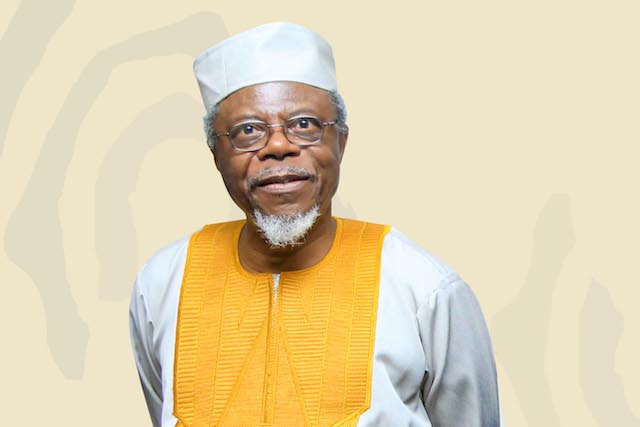
On World Teachers’ Day, 5 October 2021, a diverse group of former students gathered to honor a teacher who had profoundly shaped their lives. Among them were professors, army generals, senior judges, several Senior Advocates of Nigeria (SANs), a Queen’s Counsel (QC, while Queen Elizabeth was still alive), and senior public servants. All shared a deep gratitude for the inspiration, motivation, and mentorship they had received from Oluyemi Oluleke Osinbajo, a law professor and SAN who became Nigeria’s fifth elected vice‑president on 29 May 2015.
The 2021 tribute marked forty years since Osinbajo joined the University of Lagos faculty as a 24‑year‑old law lecturer, beginning a lifelong commitment to ideas, teaching, and mentorship. He held a graduate law degree from the London School of Economics and Political Science (LSE). When Muhammadu Buhari first assumed power as Nigeria’s military Head of State at the end of 1983, Osinbajo was a 26‑year‑old in his third year of lecturing. Eighteen months later, Ibrahim Babangida, Buhari’s army chief, overthrew his boss, citing anti‑democratic behavior, regionalism, factionalism, and economic woes. Over the next thirty‑two years—culminating in his unexpected emergence as Buhari’s running mate on the winning 2015 ticket—Osinbajo built an impressive record in academia, civic activism, public service, and legal practice, mastering the intricacies of policy advocacy and public‑service reform.
Osinbajo’s background was equally remarkable. Born in Ikenne, Ogun State—home to Chief Jeremiah Obafemi Awolowo, whose granddaughter Dolapo would become his lifelong partner—he grew up in a region celebrated for the humanist activism of Tai Solarin, founder of the Mayflower School (established 1956, a year before Osinbajo’s birth). His primary education was at the Corona Schools Trust in Lagos, followed by high school at Igbobi College, where he earned numerous prizes in English, literature, and history, foreshadowing his later forensic and oratorical skills. After graduating from the University of Lagos Law Faculty in 1978—winning the top prize in commercial law—he became a lawyer in 1979 at the age of 21, the same year Nigeria returned to civilian rule.
In August 1985, General Babangida, seeking civilian consent for his military government, appointed Bola Ajibola, then president of the Nigerian Bar Association, as federal Attorney‑General. Two years later, Ajibola invited Osinbajo, then in his seventh year of lecturing, to join his team of advisers alongside Awa Kalu, an outstanding practitioner‑academic from the University of Ife. Together, Osinbajo and Kalu spearheaded arguably the most ambitious legal‑reform programme ever undertaken by the Attorney‑General of the Federation, touching criminal law, family law, evidence, procedure, international treaties, and institutions. When Ajibola left in 1991 to become a judge at the International Court of Justice, Osinbajo continued the work with his successor, Clement Akpamgbo, also a former lecturer and NBA president.
Returning to academia, Osinbajo became a Professor of (Public) Law at Lagos State University before rejoining the University of Lagos. His unobtrusive skill in activist lawyering blossomed, allowing him to resist the worst excesses of military rule and to align with a small coalition that dared to question the regime when most had lost the will to do so. This experience informed his later civic initiatives, including the founding of the Orderly Society Trust and the Convention on Business Integrity.
When the military transitioned to civilian attire in 1999, Osinbajo re‑entered public service as Attorney‑General of Lagos State. Over eight turbulent years, he transformed the office, introducing a pastoral dimension to the Ministry of Justice, creating the Public Defender’s Office, a Directorate for Citizens’ Rights, and a Citizens Mediation Centre. He mentored staff to view their roles as public service rather than mere legal administration, reformed magistrate courts and coroners, and reshaped perceptions of the Attorney‑General’s role.
Elected vice‑president in 2015, Osinbajo brought an intellect and record surpassing any predecessor since Dr. Alex Ekwueme in 1979. His ethos—empathy, clarity, relentless application, timeless values, and a belief in humanity’s better angels—was tested over eight years at the highest levels of Nigerian politics. While expectations were unrealistically high and many within the government quickly abandoned the platform on which they were elected, Osinbajo remained a steady oasis of thoughtful competence. When entrusted with running parts of the government, he delivered capable leadership and clear results. Some close to the president resented his insistence on rule‑based administration and his refusal to tolerate the privileged lawlessness that often characterizes Nigerian governance. Others misinterpreted his advocacy for social‑investment programmes as political pandering, while many outsiders expected him to publicly denounce the president or resign. They forget that progress sometimes means preventing the worst outcomes, a contribution posterity will likely recognize kindly.
As acting president, Osinbajo defied the timid counsel of security officials and attended the 50th‑anniversary ceremony of the Nigerian Civil War in 2017, offering a powerful symbol of national healing. In a regime scarce in empathy, he never lost sight of the pastoral role of government. On 8 March 2023, Yemi and Dolapo Osinbajo visited the North East Children’s Trust in Maiduguri—a school he founded six years earlier to educate children orphaned by Boko Haram. It was his last birthday in office as vice‑president, yet it underscored his enduring commitment to education, mentorship, and empathy, promises that will outlive his presidential tenure.



Comments are closed for this story.