
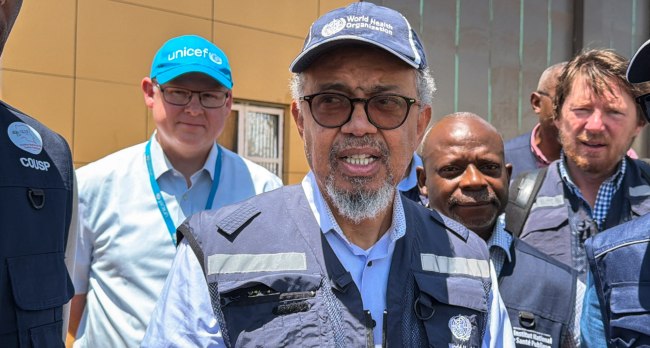
The head of the World Health Organization, Tedros Adhanom Ghebreyesus, touched down in the eastern Democratic Republic of Congo on Saturday, landing in the province hit hardest by a relentless Ebola outbreak. Speaking to reporters in Bunia, the capital of Ituri province, Tedros stressed that while global support is flowing in to help the Congolese government manage the crisis, local communities must take charge too. That’s why he came, he said: to talk directly with people on the ground, see how the response is holding up, and tackle any hurdles head-on.
The highly contagious virus has already spread across three eastern provinces in the DRC and jumped into neighboring Uganda, where nine confirmed infections and one death have been reported. Since the outbreak was declared on May 15, the Africa Centres for Disease Control and Prevention has logged at least 1,077 suspected cases in the DRC, including 246 deaths. But the WHO has warned the true scale is likely far larger, given the virus was circulating undetected for some time before it was spotted. The country, battered by decades of conflict in its impoverished east, has limited ability to run lab tests to confirm cases.
Uganda has tightened its border with the DRC this week, ordering a 21-day quarantine for anyone crossing from there. On a brighter note, the WHO announced Friday that a patient recovered and left the hospital after two negative tests—the first such recovery in this outbreak, according to WHO’s Anais Legand. Ebola, spread through close contact and bodily fluids, has killed over 15,000 people in Africa in the last 50 years. The DRC’s worst outbreak, from 2018 to 2020, claimed nearly 2,300 lives out of 3,500 cases.
Medical charity Doctors Without Borders described this outbreak as unprecedented, saying never before have so many cases been recorded so soon after an outbreak was declared. They added that the number of medical experts sent to the region is still not enough. In Ituri province, state services are nearly nonexistent, and access is blocked by insecurity linked to Islamic State-affiliated ADF militants and other militias that regularly kill civilians. Nearby North and South Kivu provinces, also hit by Ebola, have seen near-constant violence for three decades. Large areas are controlled by the Rwanda-backed M23 group, which is battling government forces.
Millions of people have fled the fighting and now live in displacement camps with poor hygiene. Nearly a million displaced people are in Ituri alone, and health officials fear the epidemic could tear through these crowded camps. Dorcas Mapenzi, living at the Kingonze camp on the outskirts of Bunia, put it bluntly: “If Ebola comes, we’ll be wiped out as we’re packed like sardines.” There is no vaccine or specific treatment for the Bundibugyo strain driving this outbreak, but the head of the Africa CDC said Thursday that a vaccine should be ready by year’s end.

Comments are closed for this story.