
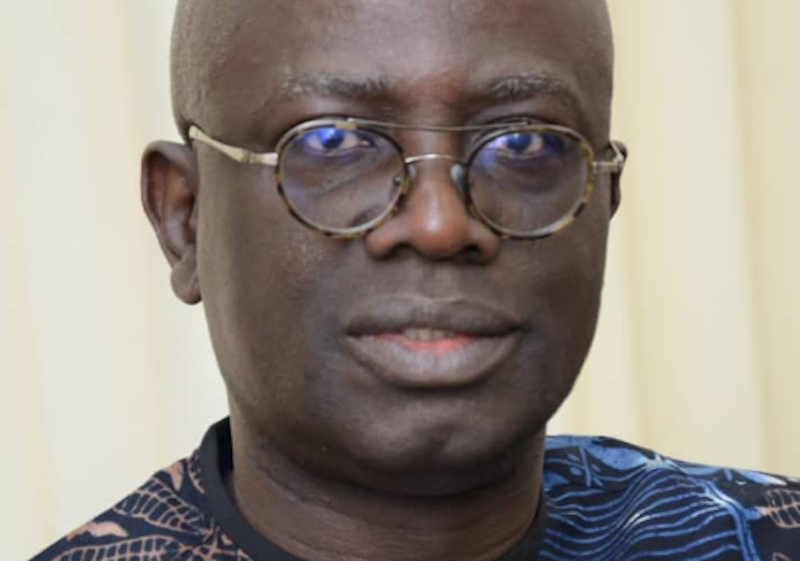
The story of Abdoulaye Wade, the former Senegalese president who turned 100 last Friday, is a testament to patience. He ran for office four times over 22 years before winning at age 74. Yet, as Nigeria’s opposition politics churns, the lesson of Wade’s persistence is lost on those who dismiss former Vice President Atiku Abubakar’s multiple bids as irrelevant. Atiku’s current battle, however, is not about his age or record. It is about the unraveling of the African Democratic Congress (ADC), the vehicle he hopes will carry him to victory in 2027.
Just days after Atiku was declared the ADC’s presidential candidate, his opponents, former Transportation Minister Rotimi Amaechi and businessman Mohammed Hayatudeen, issued separate statements condemning the process as flawed. Atiku tried to mend fences by visiting them at home, but then Babachir Lawal, former Secretary to the Government of the Federation, went rogue. In a blistering statement, Lawal trashed Atiku as unworthy, even suggesting that President Bola Tinubu, whom he also derides, might be a better option. On Channels Television, Lawal doubled down, casting more doubt on Atiku’s candidacy.
Lawal’s outburst is not surprising to those who know him. He is a man driven by identity politics, ethnic and religious. I recall two encounters that reveal his mindset. Shortly after his appointment as SGF in 2015, Lawal met with northern journalists and media owners. He spent more time praising Tinubu than his own boss, then dropped a bombshell: “Why won’t I praise Tinubu? Do you think any of my northern brothers would recommend a Christian like me for the position?” He then launched into a tirade about ethno-religious marginalization, ignoring attempts to steer him back to the administration’s agenda.
The second encounter, in August last year, was lighter but equally revealing. Former Sokoto Governor Aminu Tambuwal had just been released by the EFCC after a night in detention. Lawal joked that Tambuwal got off easy because he is Fulani. “You spent just 24 hours with EFCC and they released you. In Nigeria, all animals are equal, but some are more equal than others. Me, as a northern minority and Christian, I spent many days in detention…” He then turned to former Imo Governor Emeka Ihedioha and chuckled, “The day they catch our Nyamiri brother here, his own treatment will be special. He will spend at least a year in detention.”
Atiku’s media team has been firing back at Lawal, who likely enjoys the fight. But the real issue is how the ADC, launched with fanfare last year as a vehicle to unseat the incumbent, has quickly disintegrated. The implications for 2027 are grim. Politics should be about issues and personalities, but Atiku is increasingly seen as the problem. Even before Lawal’s eruption, the discovery that the ADC was built around Atiku led Peter Obi and Rabiu Kwankwaso to exit and form the National Democratic Congress (NDC). There is no sign that Amaechi and Hayatudeen are fully onboard.
A unified opposition can galvanize the populace and dent the myth of incumbent invincibility. But today, the opposition is splintered across parties, and within those platforms, there is no unity. My research at Harvard on African presidential elections found that fractionalized opposition is a disaster. Dr. Issaka K. Souaré of the Institute for Security Studies describes many opposition leaders as “macro democrats and micro autocrats” who seek power for themselves, not democratic progress. If they cannot lead a coalition, they go it alone, even if it means losing.
Last Friday marked 27 years of unbroken civil rule in Nigeria. Yet we keep electing people who make no real commitments. It is no surprise that Lawal’s attack on Atiku is trending while Nigerians struggle to feed themselves and schoolchildren are abducted. Now that Lawal has retreated to his farm in Adamawa, we must refocus on what matters. But that requires reorienting parties that are not founded on ideas. Without that, we will continue to produce leaders who champion nothing.
Atiku should not be derided for his age or failed bids. But this is likely his last shot; he turns 80 in November. I will return to interrogate his motivations, but for now, the ADC must put its house in order. Interested readers can access my 2011 publication on fractionalized opposition: https://olusegunadeniyi.com/projects/1077-divided-they-run-united-they-lose-how-fractionalized-opposition-strengthens-african-incumbents.html?lang=en.
Three weeks ago, I got a call from Pastor Biodun Adebowale, an old friend from our RCCG days in Lagos. She was driving through Ikoyi when she spotted a familiar building: the old Credite Bank headquarters. She had worked there in the early nineties. The structure still stands, prime real estate in one of Lagos’s most expensive areas, but it is a ghost. The NDIC took over the failed bank’s assets years ago, and the building has been left to rot. Another property in Isolo is in similar decline. “Why can’t somebody do something with it?” she asked. I told her what I always say about Nigeria: it is complicated. But that is also an alibi.
I have written about the morgue of abandoned projects, the cemetery of Nigerian ambition. Power plants that never powered. Water schemes that became monuments to inertia. Hospitals that exist only in reports. Nigeria has a genius for abandonment. We start things with fanfare, then walk away, leaving the carcass for the next administration to ignore or rebrand.
The Credite Bank building is a different category of failure. An abandoned road is an unfinished project. This is a prime asset left to rot for three decades. The numbers are staggering. The Chartered Institute of Project Managers of Nigeria says abandoned projects are worth N17 trillion. The Nigerian Institute of Quantity Surveyors estimates 56,000 abandoned projects. A committee under former President Goodluck Jonathan found that 63 percent of projects since independence have been abandoned. BudgIT’s Tracka tracked 2,760 capital projects in 30 states under the 2024 federal budget, with N2.26 trillion allocated. Their finding: 28.8 percent of those projects, worth N219 billion, were never executed despite funds being released. In Taraba, of 96 tracked projects, 29 were abandoned. In Benue, 42 percent were abandoned. The pattern is systemic: Nigeria spends heavily but plans poorly.
What is perverse about the Credite Bank situation is that the NDIC has had custodianship of these properties for years. I understand the legal complexity. Creditors must be satisfied, courts must be approached. But why must legal resolution mean physical abandonment? There are instruments available: temporary concessions, caretaker arrangements, revenue-generating tenancies. These are standard in jurisdictions that take asset management seriously.
But taking asset management seriously requires an institutional culture that values continuity. Every administration arrives with its own priorities and contractors. What came before is inherited awkwardly or ignored. We have no national doctrine for completing other people’s work. We have a national talent for starting fresh, then walking away.
The result is visible everywhere. The NDDC has abandoned 1,587 projects in the region it was created to serve. Ajaokuta Steel, into which Nigeria has poured over $8 billion since 1978, remains unfinished. We spend $4 billion annually importing steel we could produce. The Mambilla Power Project, conceived in 1972, is still being conceived. The Oyan Dam turbines, inaugurated in 1983, have never generated a single unit of electricity.
A country cannot normalize this level of waste without consequences. Once citizens expect abandonment, governance loses meaning. It becomes a performance. We have been performing this drama so long that the audience has stopped watching.
The old Credite Bank building in Ikoyi will probably still be standing in another decade, locked, fading, indifferent to the governance failures it has survived. Its endurance is ironic. The structure has displayed more continuity than the institutions responsible for managing it. That is the real tragedy of the republic of unfinished things: in Nigeria, buildings often remember their purpose longer than governments remember theirs.



Comments are closed for this story.