
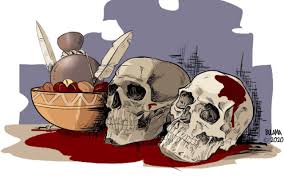
There are crimes that jolt a nation. And then there are those that lay bare its soul. Nigeria’s epidemic of ritual killings, body-part harvesting, and occult fraud belongs to the second, more terrifying category. These are not isolated acts of savagery but a mirror reflecting a profound national sickness, argues a distinguished fellow of the National Defence College.
The ritualist is not a monster from the shadows. He is a product of a society that has torn wealth from work, success from scrutiny, and spirituality from ethics. He thrives where institutions crumble, where poverty humiliates, where sudden riches are worshipped without question, and where fear is a currency. He survives because too many have stopped asking the most basic moral question: how did he get the money?
To treat ritual killing merely as a crime is to miss the point. It is the visible tip of a vast criminal spiritual economy. Within it are killers, recruiters, body-part traders, fraudulent herbalists, rogue clerics, and political patrons. The victim may die by one hand, but the moral machinery that made the killing possible is far larger than the person holding the knife. This is why the subject must be discussed without hysteria, but also without cowardice.
Not every traditional practitioner is a criminal. Not every marabout is evil. But it is dishonest to deny that a criminal class hides under the cloak of spirituality. These are merchants of fear who promise wealth without labor, protection without righteousness, and revenge without justice. They prey on greed and desperation, telling the vulnerable that destiny can be stolen and another person’s life can become an ingredient.
The most disturbing aspect is not the cruelty of the act, but the belief system behind it. In the perpetrator’s mind, a human being has ceased to be sacred. A child becomes a tool. A woman becomes a sacrifice. Blood becomes currency. This oxygen is everywhere: in the celebration of unexplained wealth, in families that rejoice over a son’s sudden riches without asking how, in religious institutions that accept donations without moral inquiry, and in a social media culture that turns fraudsters into celebrities.
The Nigerian ritualist is not an ancient figure. He is modern. He carries a smartphone, uses dating apps, and may be involved in cybercrime. This is the “Yahoo Plus” mutation: the meeting point of digital criminality and occult imagination. It reveals a frightening truth: modern tools do not automatically produce modern minds. A young person may manipulate online identities and move money through digital platforms, yet remain trapped in profound moral darkness. Technology has not displaced superstition; it has given it new channels.
There is also a political dimension Nigeria whispers about but rarely confronts. Many citizens believe some seek occult protection for power. Whether these beliefs are exaggerated or not, their persistence tells us that many no longer see power as morally innocent. A country where people believe leadership is sustained by blood and charms has a crisis of public trust. This is not just a cultural issue; it is a governance and security issue. When trust collapses, a nation becomes expensive to govern and impossible to mobilize for shared sacrifice.
The ritualist economy feeds on vulnerability. Its victims are often children, young women, the poor, and the disabled—those whose disappearance may not immediately command attention. A child disappears, a young woman is lured, and by the time the state awakens, a body has been found mutilated. This is the final failure of a protection system that should have acted earlier. A serious state must treat missing persons as a national security concern, not a private family misfortune.
But law enforcement must also be disciplined. Fear must not become a license for mob justice. The answer to ritual killing is not mob killing. A society cannot defend human dignity by destroying it. The state must distinguish between lawful spiritual practice and criminal conspiracy. A shrine is not an embassy outside Nigerian law. A clerical garment is not immunity.
Nigeria needs moral leadership from religious and traditional institutions. They must stop honoring suspicious wealth and reject blood money. When sacred institutions accept questionable wealth, they launder more than money; they launder moral decay. Families must also recover their authority. Too many parents have become spectators before the sudden wealth of their children. The home is the first school of accountability. If families stop asking questions, the nation will inherit criminals dressed as success stories.
The deeper repair needed is the restoration of a moral economy. Wealth must be reconnected to work. Success must be reconnected to service. Human life must again be placed above ambition. No economy can flourish where trust is absent. No democracy can mature where power is suspected of hidden violence.
What is required is a five-pronged approach: specialized law enforcement for ritual-linked violence; stronger legislation that protects lawful practice but prosecutes violence; community intelligence without encouraging mob action; youth formation teaching the dignity of labor; and social accountability that makes unexplained wealth morally questionable again.
At the center of this crisis is a spiritual question: what does Nigeria worship? If we worship money, we will sacrifice people. If we worship power, we will excuse cruelty. The belief that a human being can be used—for money, power, or sacrifice—must be crushed by law, culture, faith, and family. Nigeria does not merely need to catch ritualists. It must stop producing the conditions that make ritualists possible. No wealth is worth a human life. No power is worth innocent blood.



Comments are closed for this story.