
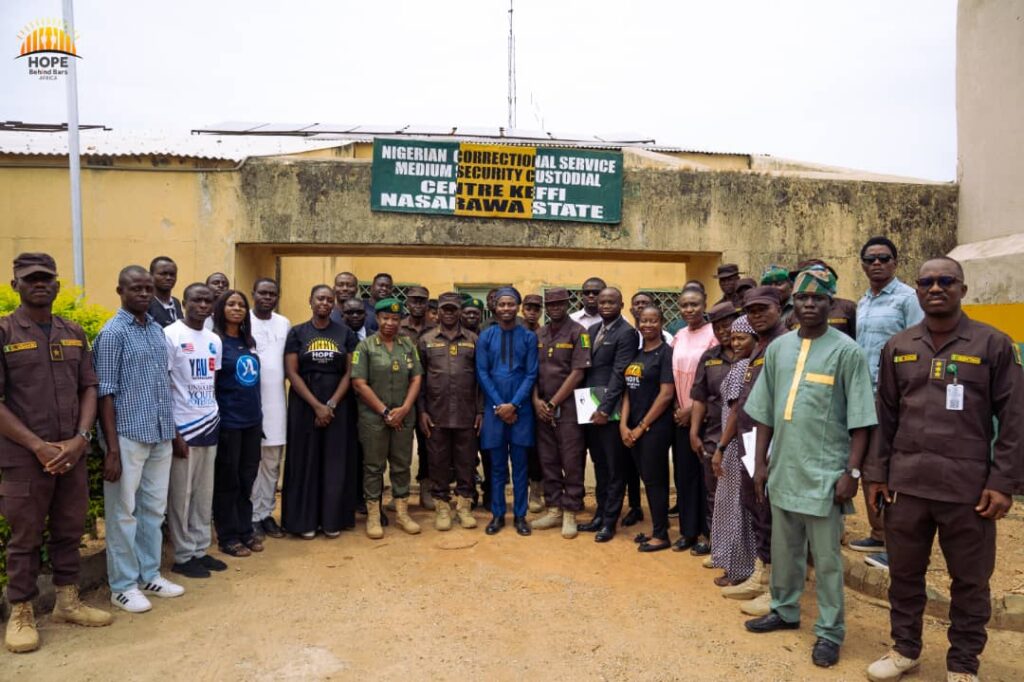
A groundbreaking project is rewriting the narrative of incarceration in Nigeria, turning a custodial facility in Keffi, Nasarawa State, into a hub of academic ambition. Hope Behind Bars Africa, backed by the Royal Norwegian Embassy and a coalition of partners, has completely overhauled and stocked the National Open University of Nigeria (NOUN) Study Centre and the National Business and Technical Examinations Board (NABTEB) Centre at the Medium Security Custodial Centre. This is not just a renovation; it’s a lifeline for hundreds of inmates seeking a second chance through education.
The transformation, executed under the Civic Accord Project, involved extensive repairs and the installation of modern infrastructure. The once-bare rooms now hum with possibility, equipped with 18 desktop computers, a 3KVA solar inverter system, printers, whiteboards, and 20 sets of tables and chairs. Over 500 exercise books, 400 textbooks, and stationery items have also been donated, creating a fully functioning learning environment.
At the commissioning ceremony, Hassan Nurudeen, Programmes Manager of Hope Behind Bars Africa, made it clear that this is about more than just bricks and mortar. “The centre already existed, but there was virtually nothing inside,” he said. “We decided to refurbish it extensively and equip it so that inmates can access quality educational opportunities while serving their sentences.” He stressed that the initiative aligns with the Nigerian Correctional Service Act, aiming to transform facilities from mere confinement centers into opportunities for rehabilitation and reintegration.
The impact is tangible. For the 666 inmates housed at the facility, this means the chance to pursue degrees—from first to doctoral levels—while behind bars. The goal, Nurudeen explained, is to break the cycle of recidivism. “People should not enter correctional facilities and come out worse than when they entered. When inmates have access to education and vocational opportunities, they become more useful to themselves and society when they regain their freedom.”
The effort drew support from the Youth Leadership and Innovation Network (YALI) Abuja, which donated a carefully curated collection of books. Deputy Coordinator Teresa Faruna emphasized the intentionality behind the selection: “We wanted inmates to derive real value from what they read while serving their time.”
The facility’s leadership is equally optimistic. Controller of Corrections for Nasarawa State, Anthony Sanda, called education the bedrock of development. “Some inmates came here without certificates. Now they have opportunities to acquire qualifications and skills that can make them useful to themselves, their communities, and the nation when they leave here.” The Officer-in-Charge, Chief Superintendent Samaila Bulus, added that the programme complements psychological support services, helping inmates stay focused and engaged.
This initiative is part of a broader vision by Hope Behind Bars Africa, which has worked with over 10,000 inmates in eight years through access-to-justice programs and projects like “Farming for Justice,” which teaches agricultural skills. The message is clear: education and opportunity can turn a prison sentence into a stepping stone, not a dead end.


Comments are closed for this story.