
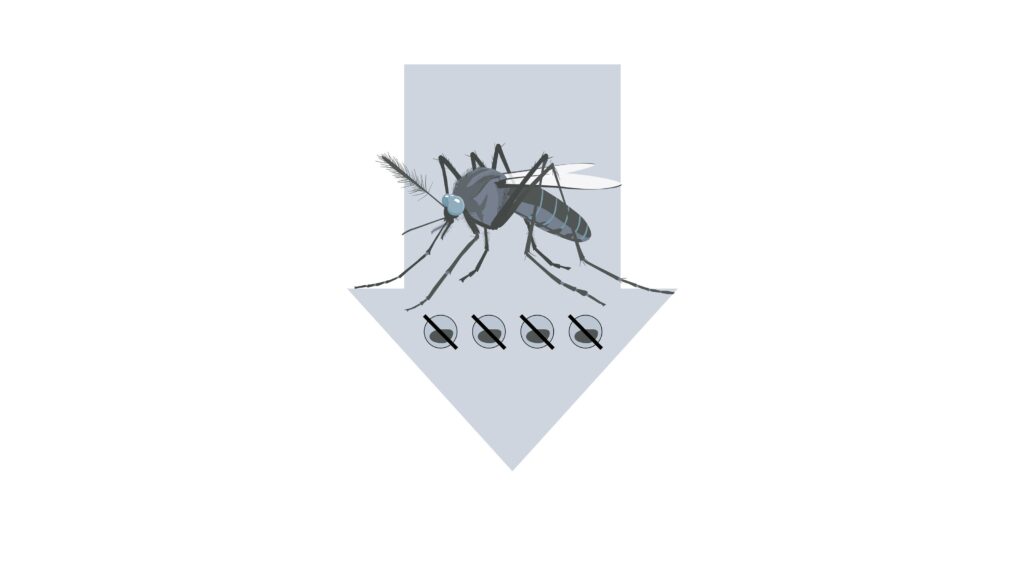
Google is asking the U.S. Environmental Protection Agency for permission to unleash 64 million sterilized male mosquitoes across California and Florida over two years. The goal: slash the population of the southern house mosquito and curb the spread of dangerous diseases.
The tech giant’s initiative, called Debug, targets the species Culex quinquefasciatus. This mosquito is a known carrier of St. Louis encephalitis and West Nile virus, which sickens more than 1,300 people in the United States each year.
Fighting mosquitoes with more mosquitoes might sound counterintuitive. But it works. Male mosquitoes don’t bite humans. Only females do, and they need blood to produce eggs. Males feed on flower nectar, making them harmless to people.
Here’s the science: The lab-bred males are treated with a common bacterium called Wolbachia. This bacteria makes them sterile. When they mate with wild females that lack Wolbachia, the resulting eggs never hatch. Fewer eggs mean fewer mosquitoes.
Wolbachia poses no risk to humans or animals, according to the Centers for Disease Control and Prevention. And the mosquitoes are not genetically modified.
Debug uses what’s known as the suppression method. In the first year, about 16 million sterilized males would be released in Florida and another 16 million in California. The same numbers would follow in year two, according to a notice in the Federal Register. The notice does not specify which counties or cities would host the releases, nor the exact timing.
By contrast, the World Mosquito Program uses a replacement method. They release mosquitoes that already carry Wolbachia, which prevents them from transmitting diseases. “Evidence indicates that Wolbachia works in two ways within a mosquito,” Gregor Devine, the senior scientific director of the World Mosquito Program, told USA TODAY.
Wolbachia is naturally found in many insects worldwide. When an infected insect dies, the bacteria dies with it and decomposes. It works on a species-specific basis, meaning it only affects the target mosquito. The CDC has used it successfully on fruit flies, screwworms, and codling moths.
Debug has also tested Wolbachia on male Aedes aegypti mosquitoes, known as the yellow fever mosquito. That species spreads dengue fever, Zika, and chikungunya. Trials in Texas, California, Singapore, Thailand, Mexico, and Australia have shown success.
There is a catch. “When mosquitoes with Wolbachia stop being released into an area, the Aedes aegypti mosquito population will slowly return to normal levels,” the CDC warns. The method also requires large numbers of sterilized males to be chilled, packed, transported, and released. In areas with high mosquito populations, repeated releases may be needed.
Still, the approach is considered more environmentally friendly than pesticides. The public can comment on the EPA’s plan until Friday, June 5.
Contributing: Kimberly Miller and Sarah Perkel, USA TODAY NETWORK. Sources: USA TODAY Network reporting and research; Reuters; National Institutes of Health; Centers for Disease Control and Prevention; World Mosquito Program.




Comments are closed for this story.