
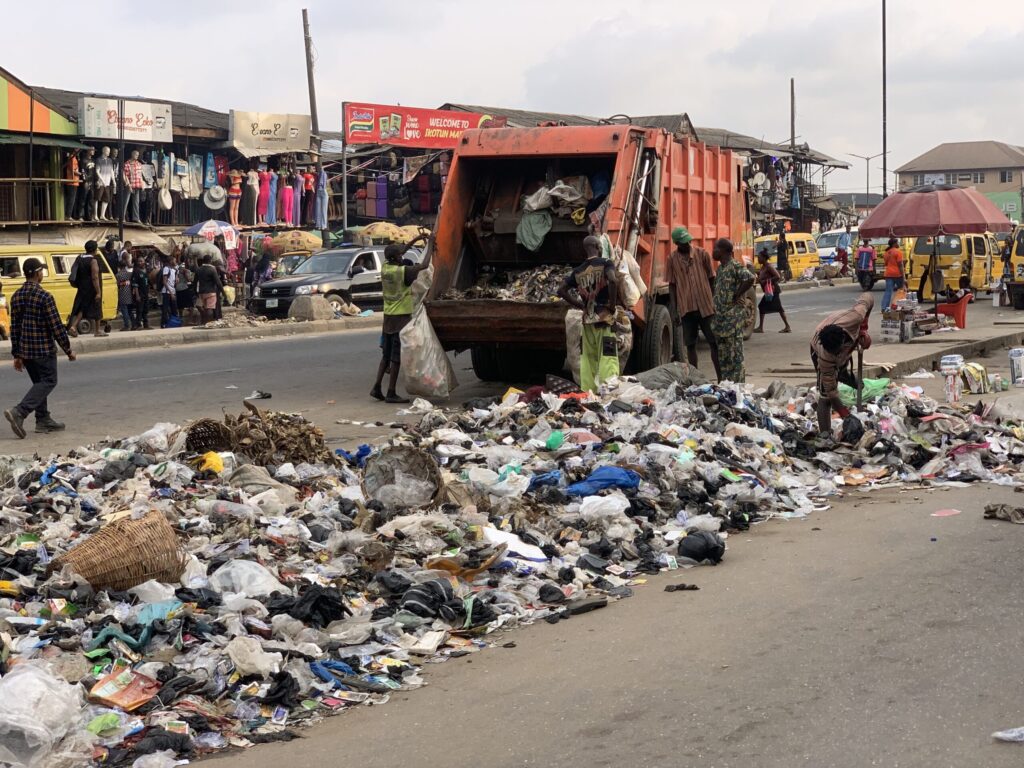
Christian Mbalisigwe spends his days with flies buzzing around rotting trash just meters from his point-of-sale stand at the Jakande roundabout in Ejigbo, Lagos. Commuters on packed buses cover their noses or step over food waste, black nylon bags and dirty water trickling from piles of refuse in the middle of the road. For Mbalisigwe, the stench is now part of daily life.
“It wasn’t like this before,” the 43-year-old said, recalling when the road median stayed mostly clean. “Now, everywhere starts to smell when it is not cleared. We just have to manage it.”
Lagos, home to over 22 million people, produces an estimated 13,000 tonnes of waste daily. Only about 54 percent makes it through the city’s official disposal system. The rest ends up in open dumps, drainage channels, roadsides and waterways, according to a 2024 World Bank assessment. The consequences go far beyond ugly piles. The World Health Organization warns that poor waste collection contributes to environmental and marine pollution, blocks drainage, and fuels flooding. Stagnant water raises the risk of cholera, malaria and dengue.
In 1997, Lagos assigned licensed operators known as Private Sector Participants, or PSPs, to collect waste across the city. The Lagos State Waste Management Authority, LAWMA, says there are now 454 licensed PSP operators serving 376 wards. Under the Lagos State Environmental Protection Law 2017, residents must register with the assigned PSP and pay a monthly fee for door-to-door collection. But a World Bank report found that only 67 percent of households have access to any waste collection service.
Our investigation reveals the system is under severe strain. Operators face low payment compliance from residents, which weakens service delivery and leads to irregular collection schedules. In Jakande Estate, residents say collectors come once a month instead of weekly, forcing waste to pile up at home. Kayode Adeshina, a former vice president of the estate association, said irregular collection has eroded trust.
“They’re supposed to come at least three times a month, but they come once,” Adeshina said. “When they collect the month’s money, about 1,000 naira, they will not come again and will give the excuse that the dumping site is full. So you will see people dumping their refuse in every corner of the zone.”
Many residents now resort to dumping on streets or hiring informal cart pushers who use wheelbarrows to collect refuse from house to house. In Ikeja, Mushin, Alimosho, LASU-Ojo road, Surulere, Ikorodu, Abule Ado and Tinubu Square on Lagos Island, road medians and bus stops have become informal dumping grounds. In Ijegun-Ijagemo Road, a densely populated area in Alimosho, residents say formal collectors don’t service the area, leaving cart pushers as the primary option. The Lagos State Government banned cart pushers in 2018, saying they worsen illegal dumping and environmental degradation.
A 2025 report by the African Cities Research Consortium highlighted that poor logistics, weak infrastructure and government inefficiencies have created gaps filled by informal waste pickers who lack the capacity to handle the volume. Residents say wheelbarrow operators are often more accessible and responsive than formal collectors.
“I rely on cart pushers several times a month and pay between 500 and 700 naira each time to dispose of my waste,” said a resident along Ijegun-Ijagemo Road, who spoke on condition of anonymity for fear of being targeted.
Waste collection contractors say they are struggling with rising fuel prices, which have increased operational costs due to long trips to overstretched dumpsites like Olusosun in Ojota and Solous III in Igando. In Jakande Estate, Golden Pond Limited and Veedic Nigeria Limited service 32 zones. Bukola Olaigbe, a manager at Veedic, said most residents are unwilling to pay.
“The price we give them is barely 1,500 naira per flat a month, yet it is still difficult for them to pay, and they want us to come often,” Olaigbe said. She said only about 15 out of over 1,000 residents consistently pay, making it hard to maintain trucks, pay workers and fuel operations.
The rise in diesel prices has worsened pressure. Olaigbe said drivers spend hours navigating congested roads, flooded dumpsites and long distances. Some operators have to bribe their way at times, she added. In May 2025, the Lagos State Government announced plans to shut down Olusosun and Solous III as part of broader waste management reforms. Budget documents show 2.24 billion naira was allocated for construction and rehabilitation of public facilities, including dumpsites.
Giwa Moshood, site supervisor at Olusosun Landfill, disputed claims of excessive waiting times, saying evacuation typically takes about two hours in the rainy season and 45 minutes in the dry season. He said he was not aware of bribery allegations.
LAWMA managing director Muyiwa Gbadegesin blamed roadside dumping on weak collection capacity, poor compliance and failing equipment among PSP operators. He said the state is supporting operators with leased equipment, introducing a centralised billing system and expanding complaint channels to ensure missed pickups are resolved within 24 hours. He also plans to install transfer loading stations and deploy smaller tricycle compactors in areas inaccessible to large trucks.
Gbadegesin acknowledged service gaps in areas like Ijegun, saying the PSP there has failed and hasn’t been operational for a while. In December 2025, LAWMA sacked 22 PSP operators over poor performance. More recently, it withdrew licences of five operators in parts of Igando-Ikotun, Eti-Osa West, Ojo and Ejigbo.
Yet in parts of Lagos, the system works. In Magodo, a highbrow residential estate, waste collection follows a predictable schedule with regular pickups and high payment compliance. The result is a noticeably cleaner environment.
Deji Akinpelu, co-founder of Rethinking City and action researcher at ACRC, said Lagos waste reforms have largely targeted symptoms rather than structural causes. He said reducing waste at source through community recycling hubs and composting could ease pressure on dumpsites.
“Community recyclable collection hubs and food waste composting programmes are the most underleveraged tools for reducing the volume of waste reaching Lagos’ overwhelmed dumpsites,” Akinpelu said.
In March, Governor Babajide Sanwo-Olu launched a monthly cleaning exercise to tackle indiscriminate waste disposal. But in Jakande Estate, cleared sites often revert to dumping grounds within days. LAWMA supervisor Opeoluwa Odunlami said traders operating near roads are among those responsible for illegal dumping, and task forces exist to arrest and fine offenders. But the dumping continues.
Mbalisigwe said he regularly sees residents arrive with bags of refuse in cars, tricycles or on foot, stopping briefly to dump them before driving off. “There is no proper place to take it. There used to be a collection point, but it stopped. The government did not provide a place where people can dump their trash, and since there is no collection bin, people do not have an option but to dump on the roadside,” he said.
Street sweepers say scavengers searching for recyclable materials often tear open bags, scattering waste across the road. “We clear it, but it doesn’t stay clean. People come early in the morning or late at night to dump. Some even throw it from their vehicles,” said Olamide Omotayo, one of the workers.
Community leaders say repeated attempts to curb roadside dumping have yielded little result. Rukayat Muritala, councillor representing Oke-Afa Ward in Ejigbo LCDA, said several meetings involving LAWMA and private waste collectors failed to resolve the problem. She said the local council deployed compactor trucks and established a task force, but the PSP operators are not functioning well because dumpsites at Igando and Ojota are full, forcing them to travel to Epe or Badagry at higher cost.
This report was facilitated by DevReporting in partnership with Pro-Poor Development Media Network and supported by the African Cities Research Consortium.




Comments are closed for this story.